

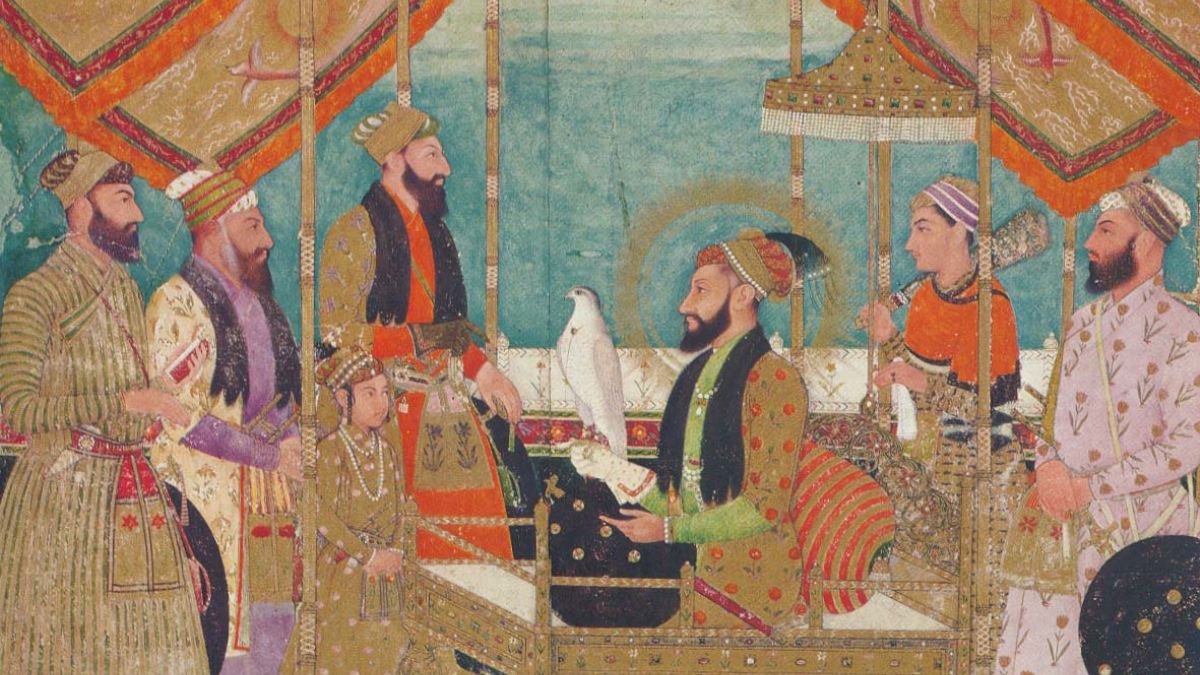
Aurangzeb’s last days
Editor’s note: A new book, Aurangzeb Alamgir and the Mughal Empire: A History Retold by Munis D Faruqui, cuts through the noise to craft a rich, balanced, and compelling account of Aurangzeb, the complex and often controversial Mughal emperor. Faruqui, via extensive research—in particular the Akhbarat or newsletters from the Mughal court—paints a vivid portrait of the ruler and his life. In this excerpt, Faruqui takes us through Aurangzeb’s last days in February 1707, as it dawned on the public that he was on his deathbed.
The original publication contains attributions/citations in the footnotes, which have been omitted from this excerpt. Aurangzeb Alamgir and the Mughal Empire: A History Retold by Munis D Faruqui has been excerpted with permission from Juggernaut Books.
*****
After ‘Alamgir’s public court session on February 16, he never again appeared in public. A previously low-grade fever had become a raging one, but despite his weakness and languor (betabi), ‘Alamgir conducted urgent administrative work from his bed the following day. What was so pressing is unknown. He also seems to have dictated or put the finishing touches to a series of letters he wanted delivered to A‘zam and Kam Bakhsh after his death. In them, he expressed his regrets about a life poorly lived and his fears of God’s punishments, complained about Shah Jahan and Dara Shukoh, conveyed his hopes and fears for the empire, offered kingly and moral–ethical advice to his successors, and gave instructions about his funeral arrangements.
Reactions at the Mughal court varied as it became clear to everyone that the emperor was at death’s door. On February 19, the day before he died, for example, senior nobleman Hamid al-Din Khan consulted an astrologer about what could be done to save the emperor. The astrologer suggested giving an elephant worth Rs. 4,000 away in alms (tasadduq). When the khan brought this suggestion to a still-lucid ‘Alamgir, he responded by saying that giving elephants away as charity was not shari‘a compliant. Instead, he suggested giving Rs. 4,000 directly to the poor. Later that evening a group of anguished nobles gathered to take auguries from the poetical works (diwan) of the great Persian poet Hafiz (d. 1389). One of them, building on widespread perceptions of ‘Alamgir as a sacred person, foretold continued religious adoration and greatness in death: “On the soil that is marked by the sole of your foot / In years to come masters of sight [i.e., religiously learned men] will prostrate themselves / When, by the head of my tomb, you pass, be graced / It will be a pilgrimage site for the profligates [i.e., true knowers of God’s truth] of the world.” In the meantime, others saw political opportunity in ‘Alamgir’s imminent demise. Zinat al-Nisa and Khidmatgar Khan IV wrote to A‘zam urging him to return immediately to the court in order to seize it following ‘Alamgir’s death.
On Friday, February 20, 1707, after a restless night, ‘Alamgir emerged – assisted by eunuch servitors – from his bedchamber and said his dawn prayers (fajr). He was then taken back to his personal quarters following breathing difficulties, and began to lose consciousness. Almost to the end, however, he continued to stroke his rosary and recite prayers. He died around 8 a.m. When word filtered out, fear gripped the court, and all of its residents went into immediate mourning. Around the same time a will, purportedly by ‘Alamgir, was found under his deathbed pillow. Between all the conflicting versions available to us today, one thing is clear: a powerful old guard, fearing for the loss of their privileges, advocated for their importance to the empire. We return to this group in the next chapter.
A‘zam returned to court the following day, established control of it, and ordered ‘Alamgir’s body to be transported (as per the emperor’s request) to its final resting place in the tomb complex (dargah) of the Chishti saint Shaikh Zain al-Din Shirazi (d. 1370), roughly eighty miles to the northeast in Khuldabad. ‘Alamgir’s burial speaks to two growing trends in Mughal interment practices from the 1670s on. The first was a preference for simple open-air gravesites in lieu of entombment in custom-built, stand-alone mausoleums. The second was burial within the dargah of a noted Sufi saint. Although ‘Alamgir’s decision to be buried in Zain al-Din Shirazi’s dargah speaks to the emperor’s personal veneration of a Chishti saint noted for his juridical skills (he once served as a qazi), simple lifestyle, and personal humility, it also salutes the historical role of Sufis and their orders in supporting Muslim rulership in the Deccan. Although Shirazi is not considered the greatest Chishti saint of the Deccan (that distinction belongs to his master, Shaikh Burhan al-Din Gharib, d. 1340), he played a key role in helping the first major Muslim regional dynasty of the Deccan, the Bahmanids, establish their independence vis-à-vis the Delhi sultans. ‘Alamgir was yoking his and his dynasty’s tenuous claims to the Deccan to the saint’s memory and blessings. Shirazi’s shrine offered yet another benefit: it contained the most important relics – including a hair and a robe – of the Prophet Muhammad in the Deccan. ‘Alamgir’s desire for close proximity to these objects would have been in keeping with his efforts to model himself on the Prophet’s example and with contemporary beliefs that holy objects channeled sacred power and blessings in this world and the next.
‘Alamgir’s death unleashed a long-anticipated war of succession, resulting in the accession of Mu‘azzam as Emperor Bahadur Shah I/Shah ‘Alam I. He was sixty-four years old, not in the best of health, and faced with myriad political and administrative crises. While historians have studied these crises, what has received far less attention is how ‘Alamgir’s complicated legacy unfolded in the reigns of his son and later successors.
*****
The original publication contains attributions/citations in the footnotes, which have been omitted from this excerpt. Aurangzeb Alamgir and the Mughal Empire: A History Retold by Munis D Faruqui has been excerpted with permission from Juggernaut Books.
 souk picks