
Raja Ravi Varma: A journey of becoming
Editor’s note: Raja Ravi Varma, the eminent 19th century artist, was one of the first to combine western painting techniques with an Indian context, and his remarkable work led to the rise of oleographs in India. Raja Ravi Varma: Painter of Colonial India by Rupika Chawla is a journey through Ravi Varma’s rise as an artist in Colonial India, featuring his stunning artworks from diverse collections as well as precious archival documents and research. Here, Chawla takes us through Ravi Varma’s early days as his work began to be recognised.
The following excerpt from Raja Ravi Varma: Painter of Colonial India by Rupika Chawla has been published with permission from Mapin Publishing.
*****
By the time Ravi Varma was fourteen years old, Kilimanur could no longer contain his youthful energies. This was the appropriate time for his uncle, Raja Raja Varma, to take him to Trivandrum [now Thiruvananthapuram], introduce him to a larger sphere of existence and provide him with the opportunities to pursue his artistic inclinations.
By 1874, the twenty-six year old Ravi Varma felt confident enough to send Nair Woman at her Toilette to the Fine Art Exhibition being held in Madras [now Chennai]. Among the many works close to the theme of this painting, it is very difficult to ascertain the exact one that he had sent. The exhibitions at Madras and Bombay [now Mumbai] were important social events attended by the cultural elite with great enthusiasm. These exhibitions were necessary for artists and painters because the publicity they derived from it provided them with contacts and commissions. Ravi Varma received a gold medal for this work and, with this exhibition, also commenced a long relationship with Madras.
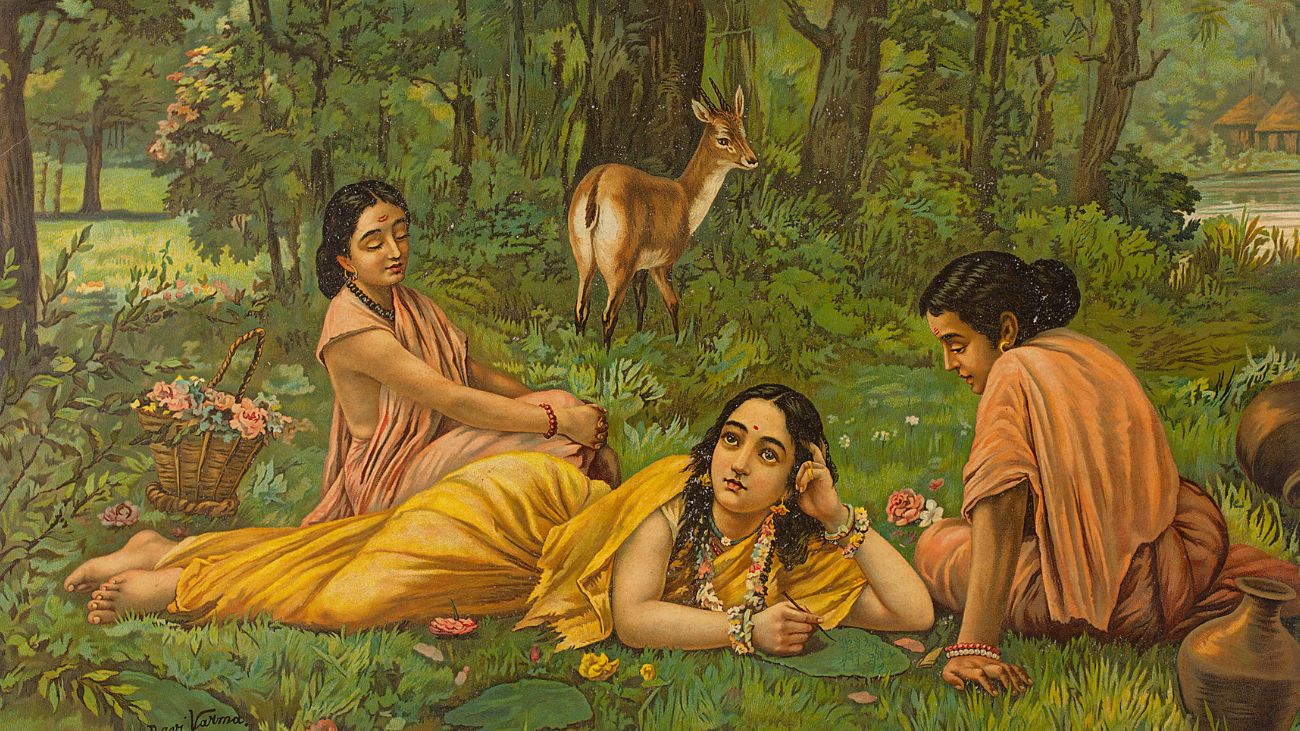
Since the reforms of British India had opened up the avenues of travel, Ravi Varma made his first visit to Madras in 1878. It was here that he sent his first Shakuntala painting, that of her writing a letter, to the Fine Art Exhibition again. This work was the first of the numerous Shakuntala paintings that Ravi Varma was to eventually make, paintings that today can be arranged sequentially to narrate the Shakuntala story. Shakuntala Patralekhan won another gold medal for Ravi Varma and was soon acquired by the Governor-General of Madras, the Duke of Buckingham and Chandos. Sir Monier Monier-Williams, the Sanskrit scholar, used this image of the reclining Shakuntala writing her letter, for the cover of the first English translation of Kalidasa’s celebrated work in Sanskrit, Abhijnanasakuntalam, the recognition of Shakuntala. There is a certain communion in the way Ravi Varma and Monier-Williams come together. The same literary work written by Kalidasa that provided the source material for the Shakuntala paintings also inspired Monier-Williams to translate it. Ravi Varma would have, of course, read Kalidasa in the original. Again, the translation and the paintings would have a lasting effect on the visual and poetic imagination of th late-nine-teenth century elite and thereafter as well. Shakuntala Patralekhan was later painted in a smaller format to be used for making oleograph prints.
Two years later, Buckingham sat for his portrait, which now hangs in the Raj Bhavan at Ooty. By 1880, Ravi Varma had already quite perfected the balance between a convincing visual image and a swiftness of execution that would soon complete an image. Buckingham made the observation that he was amazed at the rapidity with which Ravi Varma worked and “though he had given no less than eighteen sittings to an eminent continental artist, he had not produced half so faithful a likeness as the Indian artist had done”.
In all likelihood, Ravi Varma would have planned to be in Trivandrum when Buckingham arrived there for a state visit in late 1880. He documented the ceremonious welcome given to the Governor-General in an historic painting at the moment when Buckingham alighted from the splendid barge, which must have undoubtedly, brought him through the waterways of Kerala. Ravi Varma’s patron, Maharaja Ayilam Thirunal had died and his brother, Visakham Thirunal, who was now the ruler was quite inimical towards Ravi Varma. This visit ultimately proved disastrous for Ravi Varma. Buckingham’s congeniality towards Ravi Varma only exacerbated the Maharaja’s negative attitude, which in turn forced Ravi Varma to indefinitely avoid Trivandrum.
Nor did Ravi Varma and Raja Raja Varma return to Madras for some years. Life had taken on an exhilarating momentum. Fame, opportunities, travel and encounters with people in high places were gradually fulfilling their destinies. During the intervening years, the two brothers continued to send paintings to the Madras Fine Arts Society Exhibition. Raja Raja Varma, the able administrator and aspiring painter, kept in constant touch with the outcome of the exhibitions through the Morning Standard, Madras Mail and The Times, no matter what part of the country they might be travelling. He meticulously recorded the events in his diary, at times even in the oddest of places or uncomfortable situations.
On 25 February 1899, a cold, blustery Saturday, the two brothers were camping near the railway station at Karla, close to Lonavla near Poona [now Pune], and was the proposed site for their new press. Plague had ravaged both Bombay and Poona and created multiple problems for the Ravi Varma Press in Ghatkopar at the outskirts of Bombay and where work, unavoidably, was terminated. Close to where they sat, huddled in their tents, were sheds that had been built to disinfect passengers alighting at Karla from Bombay or Poona. In such an unreal situation Raja Raja Varma wrote about what was important to him: “This evening the Madras Fine Art Exhibition opens according to the papers. I am anxious to know what people think about our exhibits. This day afternoon was so windy that we were afraid lest the tent should be thrown [sic] away.”
On the first of March he writes again from his tent, “from the Morning Standard of the 27th ultimo I learnt that my painting of the Water Bearer won the prize of 50 rupees for the best figure painting in the Madras Fine Arts Exhibition”. He adds a few days later: “received letter from Mr E. Thurston, Honorary Secretary, Fine Arts Society Madras, thanking me for my present of Water Carrier (or Water Bearer) to the Society”
*****
This excerpt from Raja Ravi Varma: Painter of Colonial India by Rupika Chawla has been published with permission from Mapin Publishing.
 souk picks