

Chapal Rani, the boy who dreamed
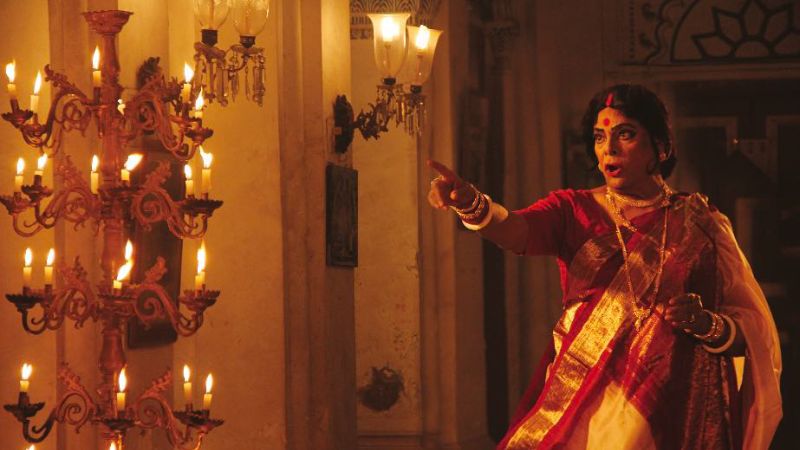
Editor’s note: Chapal Bhaduri spent all his life as a homosexual man playing women and goddesses on stage as a Bengali jatra theatre actor. In Chapal Rani, the Last Queen of Bengal: The Life and Times of a Female Impersonator, author Sandip Roy takes us on a journey through Chapal’s childhood, his relationship with his mother, his career as a performing artist, and his sexuality and gender. In the following excerpt, from the chapter ‘Childhood’, we live through Chapal’s first experience on stage as an actor, and how it brought him closer to his mother.
This excerpt from Chapal Rani, the Last Queen of Bengal: The Life and Times of a Female Impersonator by Sandip Roy has been published with the permission of Seagull Books.
*****
My favourite author was Sarat Chandra Chattopadhyay, who could beautifully depict with such simple language how a family could break apart and then come back together. I did not know then that one day I would play Bipradas’ mother in Sarat Chandra’s Bipradas. I loved those books. All those characters—Bindu in Bindur Chele, Bijoya in Datta, Bankim Chandra Chattopadhyay’s Motibibi and Rohini in Bishbriksha, and Rabindranath Tagore’s Indumati in Sheshraksha… I did not understand them all as a child. I had to read them three or four times.
Ma herself was not very educated, but she would write poetry. She even showed her book of poems to the great Rabindranath. He named that collection Gitayan. He loved her very much because she acted in many of his plays. He designed the cover for that book. It had a baul folk singer strumming an ektara while a woman sits at his feet, looking up at him. Her face resembled my mother’s. Rabindranath told Ma to use two of his tunes for two of the poems in her book. Ma recorded those songs. one went ‘Nayan jhore hai’ to the tune of his song from spring ‘Rangiye diye jao’. I would listen to the records over and over again until Ma complained, ‘Turn it off. I can’t bear listening to it.’ We had those books in the house for years until they started falling apart.
Ma also loved to watch English films. Baba told her, ‘You can neither speak english nor read it. Why do you want to watch them?’
‘You won’t understand,’ she’d say, ‘I watch the way they act, the way they depict the character. That’s enough for me. Language is no barrier when it comes to expression.’ She would go to the morning shows on Sundays, 10 annas a show, and I would tag along. I remember some of them—Caesar and Cleopatra, The Adventures of Robin Hood. I loved Errol Flynn. He was so dashing. Ma’s great idol was Greta Garbo.
But my absolute favourite thing was when Ma would say, ‘Tuklu, help me with my part.’ In those days, actors would have to keep entire parts memorised.
Ma would say, ‘I will just say my part—you follow along. If I get stuck, then prompt me with the dialogue. Give me the cue.’
Once, she said something from her part, perhaps from a play like Sita, and I said, ‘Why did you say that line like that?’
Her eyes went big. Her brows furrowed. Perhaps her theatre guru Sisir Bhaduri could do this to Prabha Devi, the queen of theatre, but I was a mere boy.
She said, ‘What do you mean?’
‘Why did you say it like that? You could also have said it like this,’ I said, and showed her. My voice was girlish, not so different from hers.
My mother looked at me wonderingly.
‘I learnt by watching you,’ I said nervously, afraid I had offended her.
‘Who are you?’ she exclaimed. ‘If you had been my daughter, what a great actress you might have been.’
Perhaps it was my girlish voice that made her say so. Perhaps it was the bits of her roles she saw me perform. Perhaps she was reminded of the unfulfilled potential of her dead daughter Sagarika. I never found out. But one day I did get my chance to act alongside her.
In 1945, Ma was acting in Sarat Chandra’s Bindur Chhele. One afternoon, I was asleep at home while Ma was at the theatre. That day there was a double show. Suddenly someone poked me awake: ‘Come with me. You have to act. Your mother is calling you.’ I was perhaps six years old then. I reached Srirangam Theatre in a state of great excitement and found out that the little boy who played Amulya had not come. I was delirious with joy. All I could think was that like Ma and Chhordi, I would also say a ‘part’. I was dressed up, my hair was tied in a knot and I was given a mud inkwell and a pen made of grass. Ma said, ‘Just listen to me and do whatever I tell you.’ The prompter Satya-babu said, ‘Don’t be nervous. Look at me and repeat whatever I say. And just open your eyes wide.’
But once I was on stage, it was like a sea of darkness out there. My little heart went pitter-patter. I was in a daze till Ma pinched me and said, ‘Say, say: “You also come, Chhoto-ma.”’ I repeated the line like a parrot. It was just a small part in a small scene. In the next scene, Amulya is older and was played by Chhordi. The audience didn’t even notice me, but for me it was a huge moment. I had stepped into the world of acting holding my mother’s hand. I got five rupees as payment for that part. All the way home, I twirled that note in my hand, waving it like a flaming torch. I kept it carefully for a long, long time. It was my first earning as an actor.
The boy whose role I played eventually got better and came back to the theatre. But by then I had got a taste of being on stage. I was extremely upset when he returned, even though I couldn’t deny him his part. He was the original actor, after all. I would go to watch the play, then come back home despondently and sit down to study.
*****
This excerpt from Chapal Rani, the Last Queen of Bengal: The Life and Times of a Female Impersonator by Sandip Roy has been published with the permission of Seagull Books.
 souk picks