

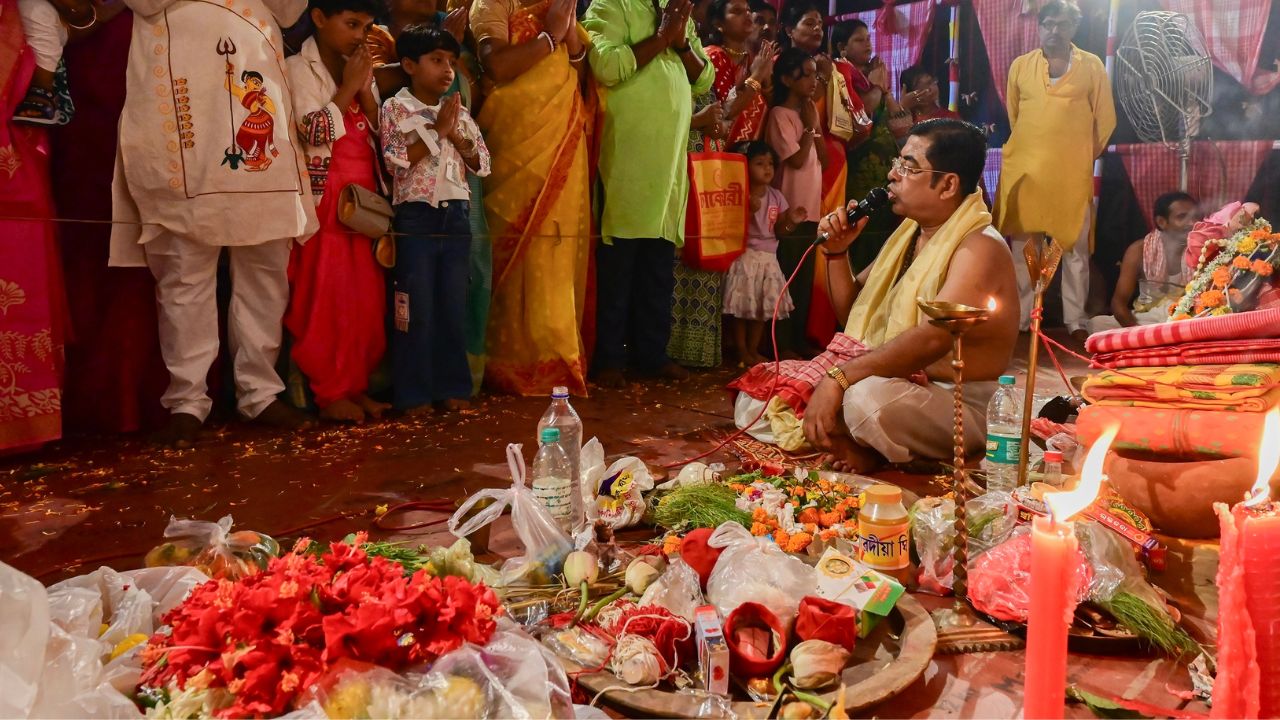
Meat & greet: A Durga Puja story
Editor’s note: In our lead essay this week, journalist Dipanjan Sinha unpacks the many meaningful rituals around food during Durga Puja through his own experience of living in Kolkata. The jarring pushback against the consumption of meat in recent times, by those unfamiliar with Bengali traditions, does a grave disservice to the diverse cultural spirit of Pujo celebrations, he argues.
Written by: Dipanjan Sinha
*****
Durga Pujo, for me, is never complete without a trip to Wellington Square, a neighborhood in central Kolkata. There are famous pandals in the area, and the lights are often stunning too. But what pulls me there every year is a roll shop on a street corner.
It began on an October evening when my father took my brother and me to the Wellington Square pandal. The date escapes me but the memory is fresh. Unlike now, October then had a nip in the air. A little away from the pandal, I encountered for the first time the beauty of a proper-sized central Kolkata mutton roll. A thick, flaky paratha, browned on the outside, wrapped around generous chunks of mutton, onions, chillies, and that unmistakable hit of lime. That was an epochal moment in the development of my taste buds.
I grew up in Taltala, a cosmopolitan locality where people from varied faiths lived. Although we spoke differently, looked different, and ate differently in our homes and in each other's homes, none of this felt singular, or even remarkable.
And come October, there was an unmistakable joy in everyone. Durga Pujo was coming. One morning the bamboo scaffoldings would be up. Over the next few days, shapes would begin to take form. Finally, one evening, we would head out into the lights, crowds, and pandals.
It was not long before I discovered Nizam's and Badshah near New Market, and later Trincas and Mocambo on Park Street. Places heavily documented, and thus familiar today due to food vloggers but, at that time, these were spaces standing on foundations of discovery and nostalgia. Eating was never merely a break between pandals. Sometimes the next destination depended on where we intended to eat.
And not merely in restaurants. There were family lunches, friends dropping in, and neighbourhood feasts for which clubs arranged provisions, cooks and people to serve. At the para pandal (a neighbourhood pandal), enormous pots of khichuri and labra, a mish-mash of vegetables often cooked as an offering to the goddess, were brought out. Accompanying them was beguni, eggplant fritters swathed in gram flour and sweet dishes like chutney, and payesh. Then neighbours queued for it, sat down together and ate. At other community lunches, mutton and big pieces of rohu were the highlights.
Some pujas remain vegetarian throughout. Families have their own rules too. Many of us fasted before Ashtami anjali and ate luchi, chholar dal, and alur dom afterwards. Then came Navami and mutton. Nobody told us that fasting made us conservative or eating meat made us progressive. We could do both within 48 hours without an ideological crisis.
Durga is not only the goddess who defeats Mahishasura. To Bengalis she is also Uma, the married daughter returning to her parents' home with her children. The old agomoni songs, ushering her arrival to her maternal house, are full of a mother's longing to see her daughter, and of the sorrow of having to send her away again. There must be new clothes, visitors, and much fuss over the returning daughter. There must also be plenty to eat.
There is an older religious history to this. In Shakta traditions, deeply rooted in Bengal, the goddess is Shakti, divine power in her own right. Some Shakta and Tantric rituals have included sacrifice, with fish, meat, and liquor as offerings. The Devi Bhagavata Purana permits sacrifice by devotees who eat meat. It does not demand it of everybody. Other families follow Vaishnava-influenced vegetarian customs. Most community pandals offer vegetarian bhog. What is offered to the goddess, what is cooked at home, and what someone buys outside a pandal need not be the same thing.
Nor is this variety peculiar to Bengal. Many families in northern India fast through Navratri, sometimes without eating even ordinary grains. Kashmiri Pandits have their own traditions of cooking mutton. For years, nobody around me felt any need to explain these differences.
***
Somehow, some of the faithful from elsewhere discovered Bengalis. And they were absolutely shocked. Here were people calling themselves Hindus and then spending their biggest religious festival devouring fish, chicken, and mutton.
In 2017, the popular YouTube cooking channel Bong Eats received abuse for posting an egg-roll video ahead of Pujo. In 2018, Fortune Foods apologised for a Pujo advertisement showing fish and meat. In 2024, videos of politicians eating meat around religious observances drew accusations of "Mughal mentality”. This year, self-styled preacher Dhirendra Krishna Shastri came to Kolkata and called the food choices of people here “ganda”.
Even Bengal BJP president Samik Bhattacharya had to explain that for Bengalis Ashtami meant luchi and Navami meant mutton. I find it curious that something our families had taken for granted now needed explaining, and that what we ate could be used to question our faith.
The food has not changed. Neither have the customs. But now there is an argument over them, and an expectation that everyone must take a side.
Are we to agree with those who find the food traditions of Bengalis objectionable? Or must we, in defending our own choices, dismiss people who believe in ritualistic vegetarianism? I find both positions difficult to accept.
Someone may fast for nine days or avoid meat altogether. Someone else may choose to eat meat. For most of my life, I had seen people make these choices without feeling that they owed anyone an explanation.
What bothers me now is that somebody else wants to measure my faith by what I leave off my plate. A choice that was once casual has begun to feel like something worth defending.
But I have no quarrel with people who fast, or with families that keep a vegetarian kitchen. I grew up among people who ate differently, among Hindus, Muslims, Zoroastrians, Sikhs, and Christians around us; Bengali, Parsi, Chinese, and Anglo-Indian families. I would not want them to forsake their practices, much like I should not be expected to forsake mine. So every year, I keep returning to Wellington Square, queueing up and completing the ritual that reminds me of a time and place that let us be. After all, Durga Pujo is all about customs.
*****
Dipanjan Sinha is a writer and editor who has been walking cities for over a decade finding stories about politics, culture and everything life.
 souk picks