

India & the world: A reporter’s dispatch
Editor’s note: Celebrated Indian journalist Saeed Naqvi’s brilliant new book, The World Was Not Their Story, provides an inside view of Indian journalism through his keen eyes. We experience the powers of corridors in India and the world from up close, as he takes us on a rollicking journey through his own career, breaking important stories and trying to hold the establishment accountable.
In the following excerpt, Naqvi talks about Indian journalists not being present at major global centres in the ’70s and ’80s, a missed opportunity on the part of newspaper proprietors. This excerpt has been published with permission from Speaking Tiger Books.
*****
The German journalist, Werner Adam, who retired as foreign editor of Frankfurter Allgemeine after successful stints in New Delhi and Moscow, once told me a story about his meeting at the Indian embassy in Moscow with Ambassador T.N. Kaul. Kaul had barely started his conversation with Adam when his secretary tiptoed in and handed him a slip of paper. ‘Dobrynin on the line,’ Kaul whispered to Adam. He then proceeded to have a conversation with Anatoly Dobrynin, Moscow’s ambassador to Washington. Dobrynin served as Soviet ambassador in Washington for more than two decades, from 1962 until 1986, and was possibly the most powerful official in the Soviet foreign office.
Adam was surprised that there were no Indian correspondents in a capital where the embassy had extraordinary access to the highest echelons in the Kremlin. The brief exchange with Dobrynin, though guarded, was ‘chummy’, with a hint of informality which is a function of a close and trusted friendship. Since the Western ambassadors did not have the kind of intimate access to the Soviet establishment that Kaul had, journalists from London, Paris or Washington were short on the kind of deep information that Kaul, the ‘old fox’ of the Indian foreign office and undeniably pro-Soviet, was in possession of.
Adam’s point was that had there been an Indian press contingent in Moscow, the various Western journalists would have found the Indian contingent resourceful and brimming with information. The world media parked in Moscow would be eating out of India’s hands.
There were countless other spots where Indian journalists could have had extraordinary access but newspaper proprietors had no interest. The ‘jute press’ had their abiding preferences: they posted correspondents only to London and Washington.
The only Indian journalist in Moscow in the 70s was the towering figure of Masood Ali Khan, a Pathan to boot, who represented the Communist Party of India organ, New Age. The CPI in India had fraternal relations with the CPSU (Communist Party of the Soviet Union). This relationship gave Masood phenomenal access to the otherwise impenetrable Soviet system. He was a mandatory fixture for all visiting Indian journalists, diplomats, progressive writers.
When the Soviet Union collapsed in 1991, Masood fell into abject penury. His salary which the Soviet system had arranged through the Red Cross was stopped. Indian ambassadors like Ronen Sen did help Masood out with a weekly stipend of three hundred dollars, but it was a pittance. His wife, from Czechoslovakia, had become a recluse because she had lost her teeth and they did not have the means to acquire a set of dentures. Masood died on the box-sofa of his one- room apartment close to a metro station. Piled up beneath the sofa were hundreds of 78 rpm records of Western classical music he had collected during better days at the BBC in London.
Informal contact with characters like Masood Ali Khan took place mostly when I was on a solo visit to Moscow. The Soviet Union cast such a lengthy shadow on South Block that more structured visits, like being part of the prime minister’s entourage, were also not infrequent.
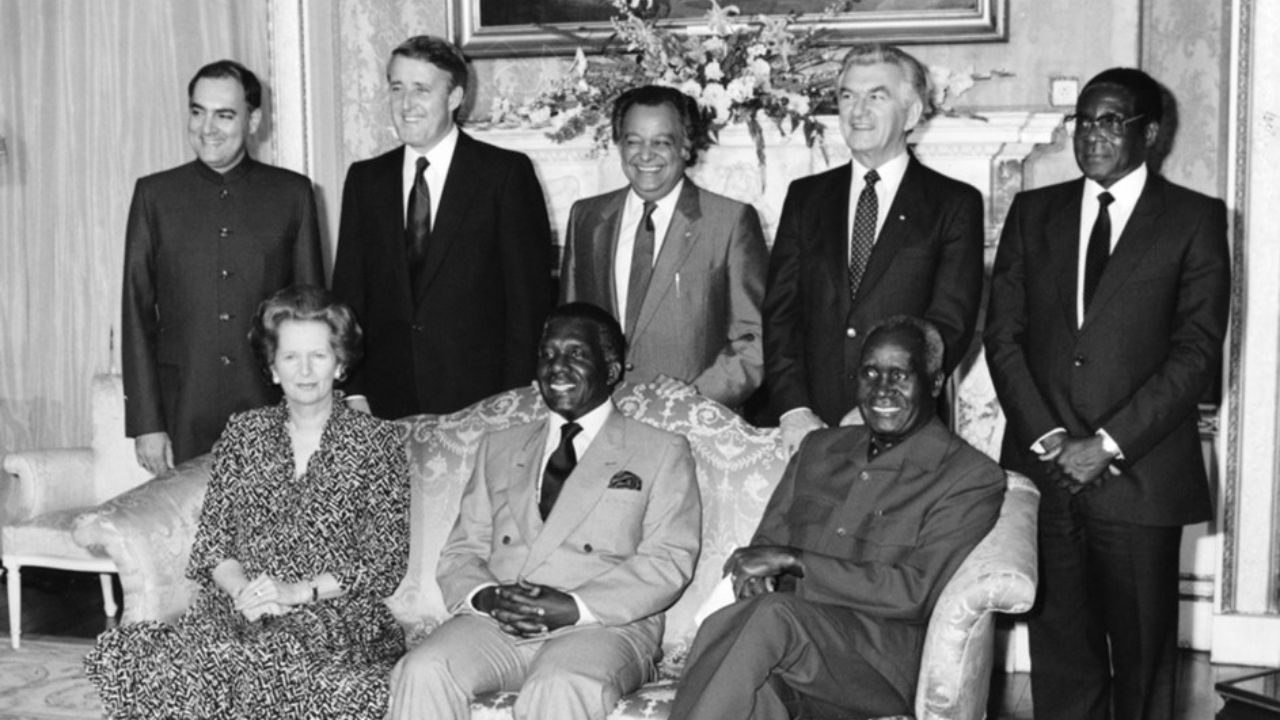
For example, in August 1986, Rajiv Gandhi invited me to accompany him to London for a mini summit on South Africa. The conference was attended by UK Prime Minister Margaret Thatcher, Canada’s Brian Mulroney, Australia’s Bob Hawke, Kenneth Kaunda from Zambia and Robert Mugabe from Zimbabwe. How obstinate the White nations were in their support for apartheid in South Africa was reflected in Margaret Thatcher’s blunt opposition to applying more pressure on the apartheid regime in Pretoria. Friends I had made in New Delhi in the British foreign office came in very handy during this session. Robin Carmichael Christopher, a senior British diplomat who served in the Cabinet Office, and who had a ringside seat at the conference, took me out on a drive where he spilt the beans generously. It was not the fashion in those days to use strong terms but Mrs Thatcher came across every bit as racist as supporters of Trump’s immigration policies are today.
The Cold War having intensified in the 1980s, one piece of real estate, the tip of South Africa, where the Indian and Atlantic oceans literally meet, was of supreme strategic importance to the West. Ending apartheid at this stage would be unacceptable to the Western alliance for a very specific reason: the anti-apartheid forces operating in South Africa under leaders like Yusuf Dadoo, Nelson Mandela, Walter Sisulu and Joe Slovo were hardcore communists. This prime strategic expanse in ‘enemy’ hands would be suicidal for the West. This is why the release of Mandela and his associates was initiated only after the fall of the Berlin Wall
in 1989.
*****
This excerpt from The World Was Not Their Story by Saeed Naqvi has been published with permission from Speaking Tiger Books.
 souk picks