

Paisa vasool: Women’s cricket comes of age
Editor’s note: Women’s cricket in India was, for the longest time, defined in relation to the men’s game, forever existing as polite symbolism. Inspirational, virtuous, motivational, dutifully moral—but never defined by personality or skill. Never its own thing. Until, that is, the magnificent triumph of the Indian women’s team in the ODI World Cup last year. The 2025 World Cup won by Harmanpreet Kaur and co. has allowed the sport to claim its rightful space.
Today, women’s cricket is both a cultural project and a thriving industry, with big brands throwing money around, expressive ad campaigns, massive contracts, and a grassroots surge. Has it shed its position as a symbol of tokenised equality? Where does the sport go from here? Even as the country revels in last week’s T20 World Cup victory of the men’s team, journalist Takshi Mehta examines the state of play for women cricketers.
Written by: Takshi Mehta
*****
“Maari chhoriyan choron se kam hai ke?”—the now-iconic Hindi dialogue delivered by Aamir Khan’s wrestling patriarch in the 2016 blockbuster Dangal was recently gender-flipped by Shafali Verma in an advertisement for the ICC Men's T20 World Cup.
The line means: are my girls lesser than boys? Verma’s words—“hamare chhore chhoriyan se kam hai ke?”—were prescient. The men in blue comfortably beat New Zealand on March 8, International Working Women’s Day, to lift the T20 World Cup for the third time.
In Dangal, that line was a defence, a challenge issued to a culture that needed convincing. Spoken by Mahavir Singh Phogat to his wife when she objects that wrestling is a man’s sport and not meant for their daughters. In the ad, it was rephrased as a cheeky challenge. The women had already won their World Cup. The men were about to take a shot at theirs, and needed lady luck on their side.
Watch Shafali Verma lay the smackdown ahead of men’s T20 World Cup 2026
For decades, the World Cup trophy had functioned as cricket’s most masculine inheritance, hoisted into folklore by Kapil Dev in 1983 and repackaged for a new India by MS Dhoni in 2011. Winning the title established instant cultural cred and clout—as it did on November 2, 2025, when India lifted its first ODI cup, captained by steel-nerved aggressor Harmanpreet Kaur; many thanks to Verma’s decisive 87 runs off 78 balls, which ensured India put up a challenging total for South Africa.
Women’s cricket is not trophy cricket
The gendered imbalance in Indian cricket was never just about trophies, but about personality. Men’s cricket has long been a personality factory: the controlled combustion of Virat Kohli, the languid authority of Rohit Sharma, the stylish restraint of Sachin Tendulkar, the charm of Shubman Gill. Masculinity rehearsed itself on the pitch learning how to rage, fail, and rise again, to be worshipped as divine.
Women’s cricket, in contrast, was not awarded that stratospheric pedestal. Its public image arrived pre-packaged as virtuous, as something inspirational, sure, but not iconic. Even during the 2025 tournament, the narrative surrounding them remained dutifully moral. This was the team that had endured heartbreak in previous finals, right from the 2017 CWC finals, to the 2020 T20 World Cup final. The team carried the dreams of millions of Indian women, taking a giant leap toward their aspiration for equality.
On the field, the tone was far less solemn. In the semifinal against Australia, India were chasing 339—a total that usually ends in defeat. Harmanpreet Kaur countered in bursts, her whip-through-midwicket strokes appearing casual until the ball vanished. On the other hand, the irrepressibly cheerful and inventive Jemimah Rodrigues stayed till the end, finishing with an unbeaten century as India completed one of the tournament’s great chases with nine balls to spare.
Watch India chase down Australia’s mammoth 339 in the 2025 World Cup
Their win was simply excellent cricket, transcending gender and prejudice, as has often been the case.
During the 2017 Women’s Cricket World Cup semi-final at Derby, England, Kaur dismantled Australia with a ferocious 171 not out off 115 balls, an innings that remains one of the most ferocious in any World Cup, men’s or women’s. At one point, Kaur stepped out and drove straight, the ball arrowing back past the stumps to the boundary. And yet when we imagine dominance in Indian cricket, it is Kohli, not Kaur, who occupies the frame.
Therein lies the real disparity. Equality in sport is not achieved when women win the same trophies as men. It is when they are freed from the moral burden of representing equality, period; when they are allowed to be excessive, polarising, even flawed.
The 2025 World Cup matters not because it politely closes a gap, but because it raises the stakes. Women cricketers are no longer auditioning for space—they now own it. The more interesting question is what happens next. Will the sport be allowed to expand beyond tokenised equality—the soft-focus language of “empowerment” and courteous celebration? Will it be allowed to turn into something messier and richer; a full-fledged drama of rivalries, egos, bad days, cult heroes, the full spectrum that births sporting mythology?
Well, signs of a significant shift are already visible in the way the players are being framed in public imagination.
Women’s cricket? Women’s market
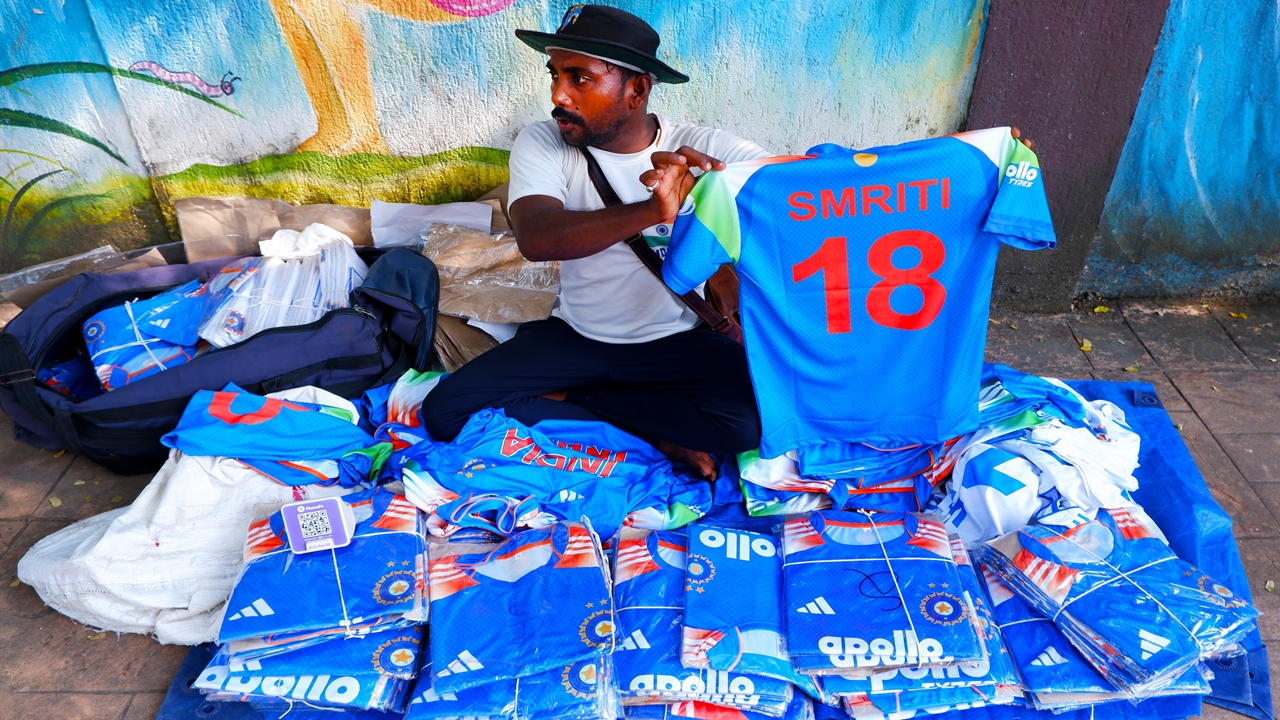
A few days back, Barbie released a doll modelled on Smriti Mandhana, in the Indian jersey with number 18 across the back. Mandhana is the only cricketer to have her own Barbie. Among the few sportswomen to have received their own Barbies are tennis superstars Venus and Serena Williams.
Mandhana and her team snatched recognition for not just themselves, but their entire profession, from a consumer brand that has largely sold aspiration, untouched by sweat, competition, and the brute mechanics of sport.
Women cricketers in India have often been accused of straying from ideal femininity. A male acquaintance once said Harmanpreet Kaur’s on-field anger looked “distasteful” and wasn’t in the spirit of the game (much as many tennis commentators said of the ‘angry’ Williams sisters when they first dominated the tennis court). Female athleticism was tolerated, even admired, but with a quiet asterisk. Mandhana found herself trolled online for displaying visible biceps. The anxiety behind the trolling was old-fashioned: strength was only welcome when it didn’t disturb the visual script of womanhood.
That anxiety has not vanished, but it carries far less authority. When Mandhana appeared on the cover of Vogue India in 2022, the most interesting detail wasn’t the styling or even the novelty of a cricketer in a fashion magazine. It was the heading of the cover story: “I don’t like the comparison between men’s cricket and women’s cricket.” A small but revealing refusal. For years, women’s cricket has been narrated largely through comparison—to men’s cricket, to patriarchy, to progress. Mandhana was asking for something simpler: the right to exist without the footnote. And while culture may still be slow to catch up, the market certainly has.
Within days of lifting the World Cup, the commercial machinery whirred to life. Business Today reported endorsement fees for leading players rising by roughly 30%, with brands pursuing multi-year contracts. NDTV Sports noted that Jemimah Rodrigues’s brand value surged by nearly 100% after her knock against Australia in the semi-finals. Today, Mandhana reportedly commands between 1.5–2 crore per endorsement, numbers that begin to approach the commercial territory occupied by Jasprit Bumrah. The figures are satisfying indeed. But figures alone do not create folklore. Language does.
Earlier, endorsements for women’s cricket would feel like moral lectures. When Mithali Raj, veteran batter and highest run-scorer in women’s ODIs appeared in Samsonite’s #TestedLikeSamsonite campaign, the metaphor was durability—grit, glass ceilings, resilience neatly zipped into a cabin bag. And it was true enough. Raj, like Jhulan Goswami and Anjum Chopra, did the hard, largely untelevised labour of making women’s cricket viable in the first place.
Mithali Raj’s Samsonite ad
But all that reverence for the struggle overshadowed skill. The narrative lingered on what they endured more than how cleanly they struck. The subtext was always: look how far they’ve come. Rarely: look how good they are. Even Dream11’s “Aadha fan nahi, Poora fan bano” campaign ahead of the 2025 World Cup the team eventually lifted felt like a prescription, as if the audience needed persuading.
That tone has started to fade. In Amazon’s Electronics Premier League advertisement with Smriti Mandhana and Abhishek Sharma, no one pauses to belabour equality. The absence of commentary has become commentary.
Amazon’s Electronics Premier League
This, perhaps, is what ‘equality’ actually looks like. The beginning of this shift in perception is accompanied by deeper, and more lasting structural changes. In 2017, the country sat up and noticed women’s cricket, when Mithali Raj’s side reached the final of the ICC Women’s Cricket World Cup. Broadcast numbers jumped dramatically (a 300% increase in viewing hours from the 2013 tournament). The system has been slower to catch up. Central contracts and better scheduling came first. Pay parity in match fees in 2022. And eventually the launch of the Women’s Premier League in 2023, which did what moral arguments rarely manage: it introduced money at scale. Once auctions, salaries, and franchise loyalties entered the picture, women’s cricket stopped being a social project and looked more like an industry.
Cricket as cultural project
Money reshapes culture. It is, after all, how men’s cricket came to author masculinity in India—through monetised repetition. A thousand matches, a thousand press conferences, a thousand advertisements that gradually birthed lasting templates. Women’s cricket is only now entering that phase of authorship, and the pipeline is growing as a result.
Since the launch of the Women's Premier League, coaches report a steady rise in girls joining academies. As per News9, Mumbai coach Prashant Shetty, who has trained Jemimah Rodrigues, says enrolment at his academy alone has increased by about 30%. Former India captain Dilip Vengsarkar’s academy in Pune now trains nearly 200 girls, enough to require additional coaching staff. In Coimbatore, academies report participation by girls rising by close to 50% over the past three years, with nearly 200 girls appearing for recent district selections.
These material changes have brought about a shift in perspective. Parents who once saw cricket as an extracurricular distraction can now see the ladder clearly: leagues, contracts, central retainers. Cricket has begun to look like a career rather than a cause.
We’ve seen what a World Cup can do, irrespective of gender. If 1983 legitimised cricket as a career for men, eventually turning it into the mammoth, all-consuming spectacle it is today, there’s little reason 2025 cannot do something similar for women.
And if you need proof, it helps to return to the beginning. Shafali Verma once had to disguise herself as a boy just to get time in the nets in Rohtak. Today she wins World Cups, and with a cheeky grin, urges the men to follow her lead.
Watch Shafali Verma’s biggest sixes in the 2020 T20 World Cup
*****
Takshi Mehta is a lifestyle writer and journalist with an enduring love for cricket, cinema, and culture. You can follow her on Instagram: @takshimehta
 souk picks