

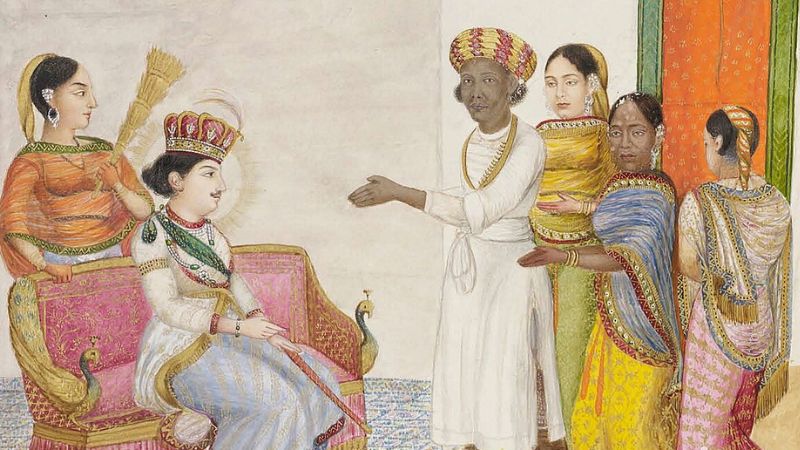
The elegies of a misunderstood Nawab
Editor’s note: Wajid Ali Shah, the erstwhile Nawab of Awadh, is too often associated with excess and debauchery—a colonial caricature of a multi-faceted king. A sprawling new book, Wajid Ali Shah: A Cultural and Literary Legacy, tries to set the record straight, shining a light on his immense cultural contributions through extensive research and study. The book, authored by Dr Kaukub Quder Sajjad Ali Meerza (his great-grandson), was originally published in 1995, and has been translated by his daughter, Dr Talat Fatima.
Here, we feature an excerpt about Wajid Ali Shah’s literary gifts via his ‘noha’ recitations—lamentations or dirges in elegy writing. This excerpt from Wajid Ali Shah: A Cultural and Literary Legacy has been published with permission from Hachette India.
*****
‘Salam’ (complimentary poetry about religious personality) and ‘noha recitation’ (lamentation/dirge) are the backbone of elegy writing. The elegy recitation (marsia goeey) was so dear to the writers of Wajid Ali Shah’s period that they did not give much attention to ‘salams’ and ‘nohas’. In this genre, the introduction of the Ghazal was considered highly objectionable because the impressive and touching feature of salams and nohas is considered its most important characteristic. Salams and nohas are usually associated with the poets of Ithna Ashri Shias and while reciting them, they cast the same spell as the poets of ‘Sufism’ while reciting ‘sufi’ composition. The salams and nohas composed by Wajid Ali Shah are an example of the same passionate poetry. His command over language, innovative style, and religious fervor are characteristic features of his compositions, which are rarely found in the poets of that era. He was carried away by the appreciation of his work. There is no match to his flow and simplicity when he composes spontaneously. Some verses from his 59-verse Salam are reproduced here:
Forest, mountain, light, Sun, Moon and the entire universe
Land and water, red and white, Imam is the owner of all
You! the Holy one, the Source of generosity, sea of valour
You! Fountain of kindness, pearl of Imamat, famous and popular
O! Pearl of the exalted river, Advisor of the Prophet’s belief
The start (matla) of ‘Ahmed’s’ Diwan, Salam on You by your appreciator
King of bravery, the killer of non-believer
King in exile, the friend of all
Progeny of the Prophet, Friend of Allah, Pious
The kernel of charity, The Prophet’s dear, the famous
You! the dearest of Sibte Ahmed, Zehra and Ali
O! Brother of Hasan, apple of Prophet’s eye
King of Kings of the World, Emperor of religion, dauntless
You the highest moon, the bright Sun
When my heart thinks of the shining face
The Sun shines on the sky
The beggar of the emperor of the Two Worlds is satisfied
You are the King of the poet, you are needed every time
Stars, Skies, Moon, Sun the sea and the good and the bad
The jinns the humans, the devils and the fairies all need you
O! The Moon of Fatima remember Akhtar surely
Come to me along with Mehdi (for my salvation)
In the above extract, there is an artistic display by the poet which is missing in the majority of his compositions. Like Ghazals, he insists on rhyming, but here he does not bother to adorn his feelings and thoughts. He also attempts to give descriptions through words as follows:
Bano said I die for you Sakina
Open your eyes and see your father Sakina
When the two earrings dangled in her ears
Strange Sakina stared at every face
‘Baiyat’ (to become someone’s disciple) was an excuse though killing was intended
O Sakina! This is the blame on Shabbir,
This was mandatory for the writer of destiny
Story of oppression was written for the heart
Crying and weeping is different from elegy
Name of Hussain is enough to impress
Alas! The portion which was kissed by Mustafa (Prophet PBUH)
This neck was the target of Shimr’s (killer’s name) sword
When in Karbala evening fell (Sham e Ghariban)
And the morning came
Zehra’s star was shrouded with the cloud of martyrdom
The moonlight faded and the sunlight became barren
The Sun of deen (religion) is eclipsed
The light of the shining moon has faded
Friends! Continue with your tears
Daughter of Zehra is imprisoned in ‘Shaam.’
Lamenting on martyrs is usually associated with women, and even today in India, when there is lamentation, it is not in eloquent Urdu and is dominated by Hindi words. When Wajid Ali Shah composed lamentations starting with the words “Bano ne kaha…” or “Zainab ne Kaha….”, he took particular care that it should not depict the common female style of lamentation. He knew that eloquence and richness of language at such a place would be undesirable. Following the advice of ‘martaba dar nazr rakh kar’ (taking care of the status) would be unacceptable in matters of lamentation. However amidst the richness of language at such a place, and the common style of lamenting, the poet wandered. In this exercise he composed one ‘salam’ in Hindi which is as follows:
Qasim the bridegroom was beheaded
Away from the bride he had a blood bath
Whom should the broken-hearted mother call
The dearest suffered the blow of arrow on his chest
The ‘maang’ (hair parting) was devastated, womb was destroyed
The ‘sindoor’ (vermillion) was no longer auspicious
When the mehndi was smeared on your palms
It was smeared with blood
No line of demarcation was drawn between ‘noha’ and ‘salam’ in Urdu, nor is any particular period fixed for their origin. However if this is done in the future, Wajid Ali Shah’s Diwan will be of great use.
*****
This excerpt from Wajid Ali Shah: A Cultural and Literary Legacy has been published with permission from Hachette India.
 souk picks