

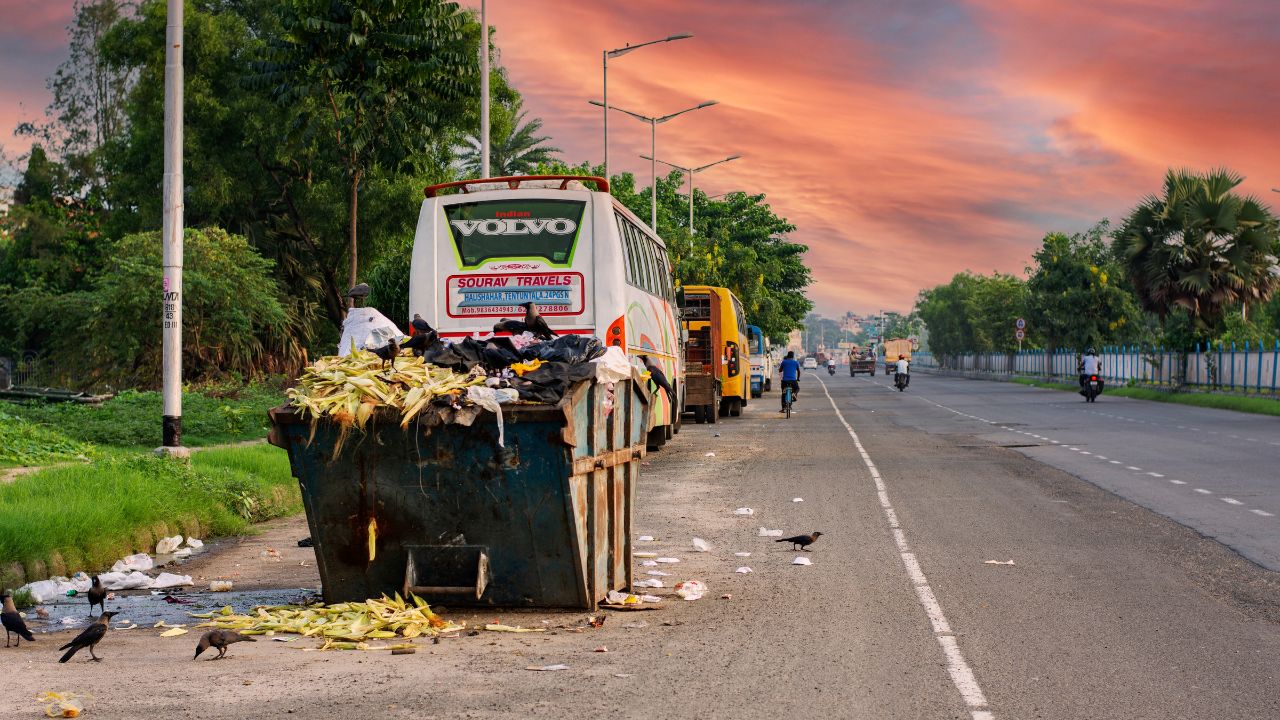
The real dirt on Indian civic sense
Editor’s note: The public behaviour of Indians travelling abroad has become a punchline on social media, an excuse for great self-flagellation and bog standard racism. In this illuminating essay, Japan-based educator Suprateek Chatterjee argues the outrage is misdirected and misinformed. What we call ‘civic sense’ has little to do with national character. In fact, transforming Japan into a model of public virtue took time, effort—and applying something called the ‘broken windows’ theory. We become what we see.
Written by: Suprateek Chatterjee
*****
Mornings at Yokohama station tend to blur into one another. Around 9 am, I step off the subway and stop at the convenience store inside the station for the usual three items: sparkling water, something edible, and black coffee. I refuse the plastic bag, stuff everything into my pockets or backpack, and join the flow of commuters toward the JR platforms.
On the way to work, wherever polite, I sip my coffee, swig my sparkling water (cupping the cap to muffle the hiss of escaping carbon dioxide), and nibble at my sandwich/onigiri/protein bar. Japan famously lacks public garbage bins, especially for plastic waste. Bottles are manageable. Coffee cups, less so. Mine travels with me until I reach the carefully segregated bins at work. I sit quietly on the train, headphones on, doomscrolling in respectful silence like everyone else around me.
Being an Indian who lives in Japan and is somewhat extremely online comes with a sense of extreme whiplash.
On social media, Japan is often treated as a futuristic utopia. “Japan is living in 2050,” proclaim reposted TikTok montages of spotless streets and everyday conveniences (some of which, it must be said, occasionally turn out to be in China).
Another video ‘oohs’ and ‘aahs’ over crystal-clear drain channels filled with koi “in Japan” — in reality, it’s just one neighbourhood of a small town called Shimabara, near Nagasaki. A viral tweet declares Japan “the only first world country,” after the writer misplaced two luxury bags and a gold necklace and had them returned intact.
Then I open Twitter — ‘X’ is still just the 24th letter of the alphabet to me — and see the opposite narrative about India. Posts about Indians lacking “civic sense” circulate endlessly: fireworks and litter in Toronto, trash at a Canadian national park, and, perhaps the biggest blow to our global image, a viral 2025 GeoGuessr challenge in which players searched randomly in India until they found a place without visible trash — not easy, to say the least.
As someone who lived in India for more than three decades before moving to Japan, this leaves me with uncomfortably mixed feelings. In Mumbai, I can confirm that I used to do all the things that Indians are (rightly) criticised for. At various times over three decades, I have littered without a thought; honked incessantly while driving; urinated by the side of the road in times of desperation; and tossed lit cigarette butts out of moving vehicles. Product of my environment or not, guilty I plead.
After moving to Japan at the age of 33, my misdemeanours have been fewer and comparatively benign. For instance, in late 2024, I honked at a car that was taking too long to exit a parking lot. In moments of impatience, I have ignored the strict garbage segregation rules and have tossed my coffee cup into the bin meant for cans and plastic bottles. I hope immigration isn’t reading this.
The term ‘civic sense’ has gained traction on the Indian Internet in recent years, surfacing frequently in social media discussions around public behaviour.
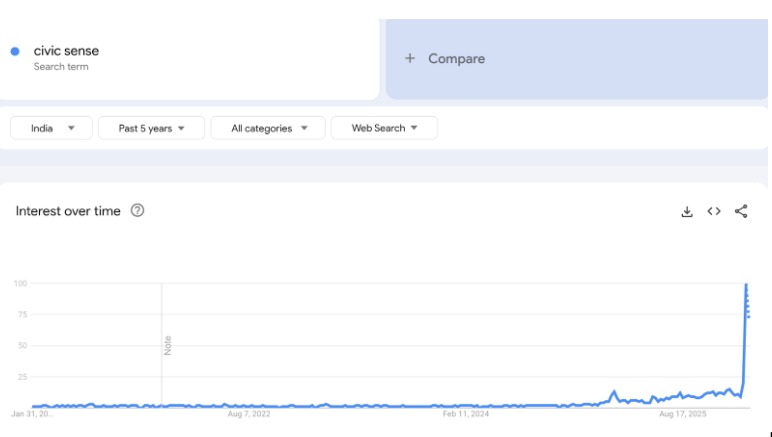 A screenshot depicting the usage of the term ‘civic sense’ on Google Trends over the past five years.
‘Civic sense’ also appears to be a uniquely Indian term – grammatically correct, but used idiomatically as an Indian English interpretation of the phrase ‘civic virtue’, which refers to “habits, values, and attitudes that promote the general welfare and effective functioning of a society”. Its Indian cousin ‘civic sense’ encapsulates public behaviours connected to waste disposal, hygiene, ability to follow both injunctive norms and rules, and overall public etiquette and decorum.
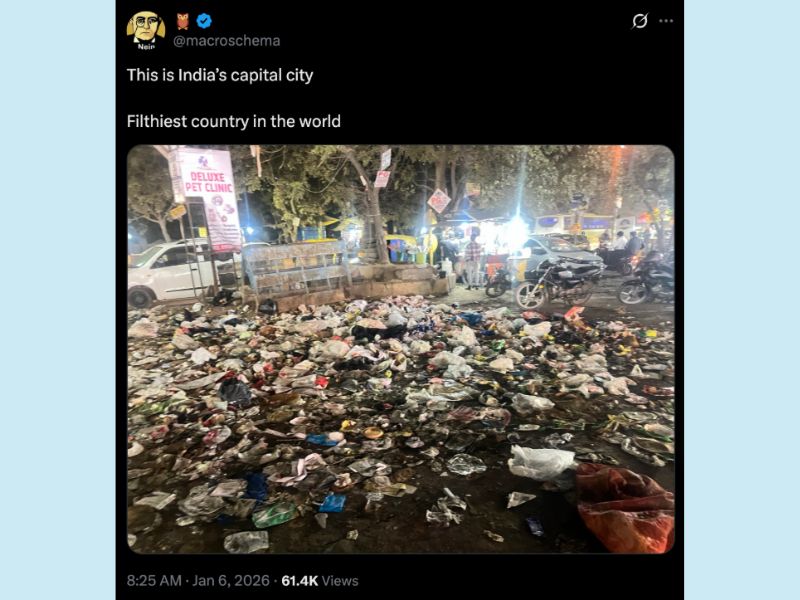
Unfortunately, much of the online discourse around ‘civic sense’ (or lack thereof) has acquired the tone of outright racism. Videos showing Indians behaving badly in public, both within the country and abroad, have become a cottage industry for verified, engagement-farming accounts, many of them chasing easy payouts. These accounts offer fodder to supporters of Donald Trump in the United States, who use these cherry-picked examples to make a case for why immigration, especially from India, is undesirable. For example:
The criticism is also increasingly directed inward, but it often seems to be sanctimoniously doled out from moral higher ground. Many upwardly mobile young Indians now routinely discuss the shortcomings of Indians’ civic sense. For example, the makers of this attempted humorous video poke fun at individual behaviour on the streets and centre the lack of civic sense as a personality issue.
They always say “India” as though it is a different country— the implication being that the problem lies elsewhere, with other Indians. At the same time, the cynicism is relentless. “Nothing will ever change in this country” is a refrain I have heard my entire life. To be honest, I am as guilty of this behaviour as anyone else.
I grab dinner and drinks in Ikebukuro, northwest Tokyo, with my friend Haruna. As we walk around the recently gentrified neighbourhood, we notice something that catches me by surprise: cigarette butts strewn on the streets; empty cans and coffee cups lying next to bushes. It’s not that there is never any litter in Japan — ‘party districts’ like Kabukicho and Shibuya in Tokyo and Dotonbori in Osaka look positively revolting on weekend mornings. But this still felt like an aberration.
Haruna notices my raised eyebrow but looks unfazed. “A lot of Tokyo used to look like this when I was in school,” she says. “It’s taken a long time for things to get to where they are now.”
Indeed, many people assume that Japan’s famed cleanliness is some sort of built-in cultural trait but, as Haruna and other Japanese friends confirm, this is, in fact, a learned virtue. As historian Robin Kietlinski points out in her research article, Trash Islands: The Olympic Games and Tokyo’s Changing Environment, concerns about cleaning up Japan’s physical environment date back to the late Meiji period (1868-1912), when industrial pollution crises had already made environmental degradation impossible to ignore.
In the 1930s, when Tokyo was preparing to host the (ultimately cancelled) 1940 Olympics, schoolchildren were mobilised for cleanup campaigns. In the postwar era, this ethos took root in schools through o-soji, where children clean their classrooms and surroundings from a young age, reinforcing responsibility and agency. The 1964 Olympics further roused this instinct. Tokyo was to become the face of postwar Japan for the world. Japan was determined to put behind the devastation and humiliation of World War II on the global stage. Sewage in Tokyo Bay at the time was not all that different to the waters along Indian coastal cities today. Industrial pollution was widespread. Flies, mosquitoes, and tobacco smoke, all became matters of immediate public concern and were serially dealt with.
Over the past decades, the Japanese government has often prioritised sweeping changes in behaviours and public safety in response to disasters, such as the 1995 Tokyo subway sarin gas attack and the 2011 Tōhoku earthquake and tsunami. Removal of public trash cans, more rules, and more gentle ‘nudging’ of people to follow rules followed. One would think that this might have led to dirtier surroundings, but in fact the effect was the opposite — as public bins became fewer, Tokyo paradoxically got cleaner, as more and more people, conscious of the broader civic goal, started stuffing their trash inside their pockets or bags to dispose of them when they could. This video, titled ‘How Japan Keeps Clean’ captures the ways in which cleanliness has now become a national habit, deeply ingrained into everyday life:
Tempting as it is to ascribe this to Far East exceptionalism, none of this transformation was due to a suddenly activated cleanliness gene in the Japanese. It happened because the country had something to prove. Clean Japan was shaped, repeatedly, by moments when national pride, international scrutiny, and environmental necessity converged.
Today, India stands at a similar juncture. The world’s fourth-largest economy — already struggling with severe air, water, and land pollution — is more visible than ever on the global stage, but also increasingly associated with bad public behaviour, be it wilful littering, watching videos without headphones, or jumping queues at airports.
I am not, admittedly, an urban planner or behavioural economist; nor am I qualified to offer any concrete solutions to this complex problem. But there is a body of research that suggests public behaviour is shaped less by moral fibre and more by cues, incentives, and expectations. Theories ranging from James Q Wilson and George L Kelling’s “broken windows” idea to Robert Cialdini’s work on social norms and Robert Sampson’s research on collective efficacy all point in the same direction: visible environments, shared expectations, and a sense of mutual responsibility can influence how people behave in public.
Some may roll their eyes, but this is already observable in practice. The broken windows theory posits that visible disorder begets more disorder; in other words, if a place is already dirty, people are likely to make it dirtier. In metropolitan cities like Delhi and Mumbai, it is common to see people carelessly litter on streets that are already strewn with garbage, but my observation has been that people would be less likely to litter inside a mall, or even a well-maintained street or neighbourhood. It isn’t just about the lack of options for disposal: intuitively, all of us know that we are far more likely to see discarded plastic wrappers at the Red Fort or the Gateway of India than inside Select CityWalk Mall or High Street Phoenix, and you would never be too far from a garbage bin in either of these places.
Here, I am reminded of a pithy comment by a friend who said: “Civic sense [in India] is inversely correlated with air-conditioning” — a bit flippant, but not entirely untrue. Clean, climate-controlled spaces tend to signal affluence and expectation; disorder and indifference is, consequently, associated with outdoor spaces for the general public.
Another aspect is that of monitoring. Even if you don’t get fined, you are much more likely to be judged or even shamed for littering at a mall or a well-maintained space than on a regular Indian street. This ties in with Cialdini's definition of descriptive social norms, which suggests that people's behaviour is influenced by how they think most other people would behave in a certain place. It certainly works well in Japan; many rules here, such as being silent and not answering phone calls on public transport, are socially enforced rather than through fines, and the prospect of strange looks from passers-by is usually enough of a deterrent. Sampson’s emphasis on collective action is also observable in India — one only need visit Gangtok in Sikkim or Mawlynnong in Meghalaya, both famed for being exceptionally clean and well-organised, to see how taking pride in one’s surroundings can be the starting point for a model that could be followed nation-wide.
I believe that a significant reason for why Indian civic sense leaves much to be desired is because we just don’t like what we see around us. This isn’t just about aesthetics — it’s also a mismatch of expectations.
We constantly hear or read about India being on the road to becoming an economic superpower, see gleaming skyscrapers and glittering storefronts pop up in our cities, but are then left dismayed by the realisation that to get to them, we have to navigate broken, dust- and garbage-strewn streets that sometimes resemble what we imagine countries with far smaller GDPs look like (spoiler alert: some of them are, in fact, transforming more impressively and rapidly than some of our cities).
In spaces where visible disorder signals neglect, we feel no need to contribute to cleaning up or maintaining such surroundings. Instead, we resort to pointing the finger vaguely towards Indian civic sense and increasing our tolerance to decay. As compensation, in private spaces — restaurants, malls, stores, gyms, and our homes — we demand and expect the First World. And thus we have the paradox that is modern India, somehow both ascendant and deteriorating at the same time.
These are not the only factors that determine Indian civic sense, of course — there are undoubtedly deep-rooted issues related to class, caste, dignity of labour and historical baggage to confront as well — but to me, a good starting point for a solution would be to drift away from “We are like this only”- or “India is not for beginners”-style cynicism, which has clearly not produced any desirable results other than reinforcing fatalistic attitudes and narratives.
Instead, a real solution could be to truly believe that we deserve better and that we can be better than this. Then, we can channel that energy into some sort of collective action that simultaneously combines individual discipline and demands for greater accountability from our elected representatives. The growing awareness of ‘civic sense’ as a term may be evidence of the former; we now need more of the latter.
As the workday ends, I am back at Yokohama station by around 9 pm. On the way to the subway station to board the train that takes me to my neighbourhood, I usually pass a vending machine with two garbage bins next to them exclusively for cans and PET bottles. Out of habit, I touch the side of my backpack and then my coat and trouser pockets to see if I have something to dispose of.
*****
Suprateek Chatterjee is a freelance writer and educator based in Japan.
 souk picks