

Made in India: A new kinda spice girl
Editor’s note: India’s Gen Z pop era has just begun. Hooks that crawl into your ears, elaborate stage designs with couture to match, backup dancers that don't miss a beat—indie music didn't look like this 10 years ago. How did we get here? And who are the artists leading this 360 degree revolution? Arunima Joshua spotlights eight exciting popstars remaking the Indian indie space today.
Written by: Arunima Joshua
*****
We’re in the age of the certified pop girlies. They may be building slowly, but they’re clearly on the way to pop domination, growing from independent scenes. Access granted by the internet has opened international doors, giving them opportunities to open shows for overseas pop acts and sign major record deals. It’s a shift from the way India has previously consumed westernised pop music.
The mind instantly goes back to the ’90s, when Indipop singers of the likes of Alisha Chinai, Anamika, Baba Sehgal, Lucky Ali, Sagarika, and Shweta Shetty dominated our screens with their stylised music videos and electric Hindi pop songs (read our fabulous essay on Indipop by Narendra Kusnur). It was an off-Bollywood movement propelled by music entertainment channels such as MTV and Channel V, which provided a young and aspirational audience with a new kind of role model. Right till the early aughts, groups like Viva and Aasma were all over cable TV and the radio. In parallel, particularly in the 2000s, a period of indie rebellion began to materialise through a rising rock and roll movement. It was a tumultuous phase of expression and rebellion, with boho and grunge acts capturing urban millennial imagination. And now, today, we seem to be circling back to a new kind of pop era, one that draws from both local and international traditions.
Today’s pop artists, existing in the Instagram age, are perhaps more polished than their millennial foresisters—replete with designer drip, intentional stage production, cute montage music videos, daily celebrity-style vlogs, brand deals, and some even touted as fashion icons.
In a more sensitive, post-Free Britney world, will they be granted kinder scrutiny, as opposed to the toxic paparazzi culture of the Y2K era, or the "damned if she does, damned if she doesn't" narrative that plagues even powerful stars like Taylor Swift and Dua Lipa today? Can they escape the objectification and trap of the male gaze hegemony in an increasingly polarised algorithm?
It’s a new age of singers crafting a distinct identity: elaborate and theatrical R&B-influenced pop, borrowing from western sensibilities and an Americanised pop culture idiom, while existing within and often emerging from the indie infrastructure of the past two decades. They stand unique amongst the other fresh, non-Bollywood music with their well-crafted visual presentations. Whether it be the I-pop route or self produced electro-pop albums, these eight exciting desi artists are rolling out eras and flipping narratives and expectations. And we’re betting on them to reach bonafide stardom.
*****
The Mumbai singer-songwriter and producer, trained in western contemporary, made a somber debut in 2020 with the beat-driven single ‘Please’. Kayan (or Ambika Nayak, who flips her surname for her stage alias) has consistently put out singles over the past six years—with fat 808 synths platforming her rich R&B vocals—racking up lakhs of followers online (2.3 lakhs on Instagram at the time of writing). She plays DJ sets across the world and has made it to the glossy mags too as a multi-hypenate creative.
You can spot her in Hindi film cameos (see: Kho Gaye Hum Kahan, 2023), opening for Ed Sheeran at his India concert, and occasionally on a fashion or jewellery brand’s packaging. Last year, she released the five-track EP Is Love Enough?. Most of her tracks come under the three-minute mark, as she collaborates with a variety of young music producers. On her Instagram you will see her teasing new music drops on reels, with hook steps that seamlessly translate onto festival stages with a dance troupe, as she sways, sings, and spins to R&B anthems in a look styled to a T.
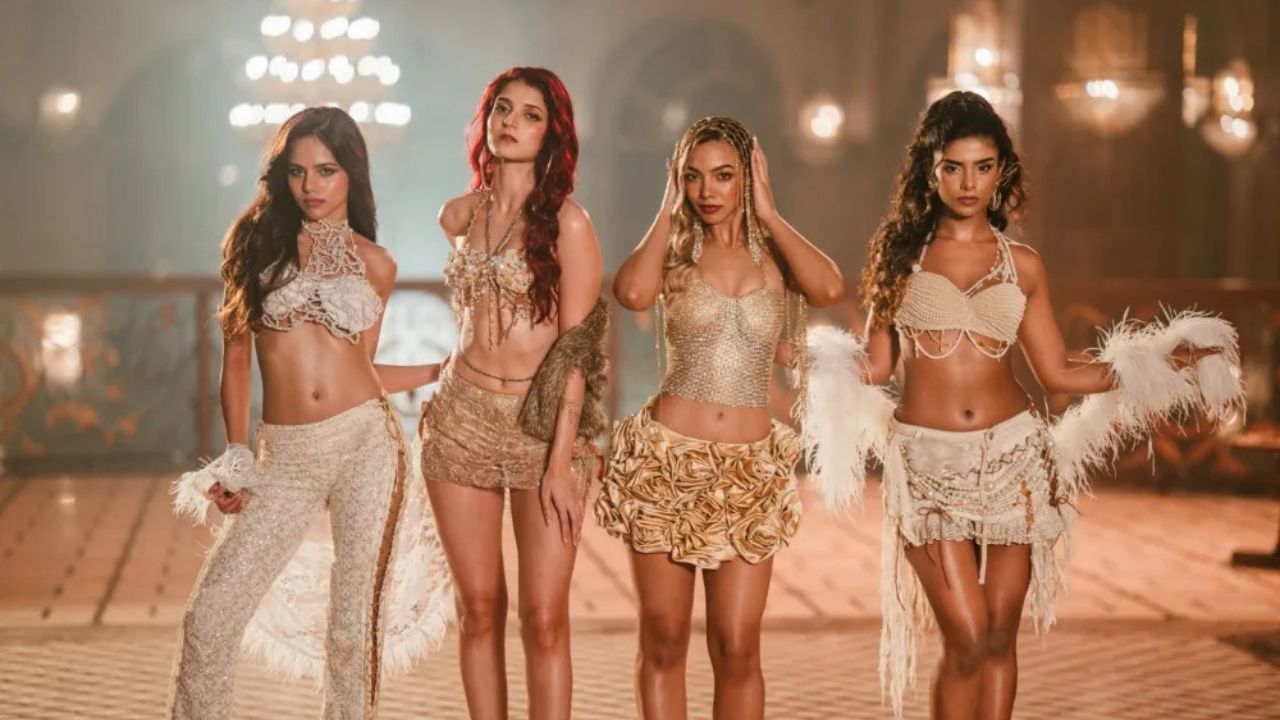
Ri, Sim, Zo, and Suchi, the four singers who comprise W.i.S.H., have arrived. Hinglish lyrics, a distinctly Indian identity, remixing Priyanka Chopra bangers, and bragging rights as Gen Z’s first girl pop act to boot. And a legit tagline—“careful what you wish for”, whispered at the start of every song. The group, mentored by Mikey McCleary, well regarded composer of jingles and soundtracks, have made it to billboards in New York; they have official merch you can buy; they’ve even collaborated with the creators of BTS and Katseye, HYBE, to perform at the K-pop incubating company’s Mumbai event. Ri and Sim have also sung the official Hindi versions of songs from Netflix sensation Kpop Demon Hunters.
The girls can rap, sing, dance—all without a hair out of place and in cute, coordinated fits. Their recreation of Nazia Hassan’s ‘Boom Boom’ tries to introduce a new generation to the greatness of desi disco. On ‘Bolo Bolo’ (featuring rapper Panther), they create a breezy soundtrack for a teenage girls’ night with subtle reggaeton and powerful harmonies. With opening sets for Akon and Armaan Malik already under their belt, as well as a dedicated young following online that’s busy making dance reels to their chorus hooks, the foursome’s mainstream era has only just begun.
Black leather. Strobe lighting. Slick editing. The 22-year old is framed by hazy flares and motion overlays in the video for ‘No One’s Baby’, as her voice flows over snaking synths and kick-and-snare drums.
Kiara Chettri arrived on the indie scene as a teenager with a sweet singer-songwriter energy. After completing her studies in London, the Delhi artist is now aiming for global pop domination with polished, beat-driven compositions. On ‘Down’, for instance, heavy reverb and a tropically-tinged rhythm produce a solid hook anchored by Chettri’s deadpan vocal delivery, which takes on a more delicate form later in the song. She belts out high notes à la Alicia Keys, picks dance crews that blend with the aesthetics of her music videos, and writes relatable and earnest lyrics. While still a new kid on the block for now, on paper, Chettri seems to have everything going for her to be a main pop girl.
Earlier this year, at Lollapalooza India, Indian-American singer-songwriter Zoya held up a sign that read: ‘Indian Girls Can Make Pop Music Too’. Her crew displayed the slogan on their tees as well. Dressed in a grungey denim-on-denim look she collaborated on with her stylist, Zoya performed her album Bad Girls Dream, which features ‘First Class’ hitmaker Jack Harlow. It was part of an ambitious setlist that was recorded and released on YouTube.
This statement tee is available for purchase on her merch store, where she also sells intimate wear for women. Riding the wave of Bad Girls Dream, released in 2025, her current ‘era’ sees her writing and recording her next album, titled Feast. Her music is hard to situate within the established pop music framework, with diary-like vocals set over charming electro-pop, delivered with the trademark twang in her voice.
As for the visual vocabulary she employs: her last full-length music video, for ‘Life’, had a candid Y2K-cinematography style, as she gazed sunkissed into the lens at the beach. And if the visualisers for The Human Era Is Over (The I/O) are anything to go by—with Zoya eating fruit or running around the beach—we should expect more coastal content from the Los Angeles-raised artist.
At just 20, Gini already has a collaborative song, ‘Aashiqana’, with Indian Ocean, titans of independent music. The song was part of new-age producer Chaar Diwari’s EP Parvana. On her verse, she brings an emotive, lullaby-esque interlude to the six-minute Hindi track. It showcases the range of this gifted I-pop singer who also sings in English. Her own singles are dreamy compositions across both languages.
The Dehradun-born songwriter represents a forward philosophy of not being boxed into a single branding and aesthetics. You can catch her performing at concerts and festival stages in neatly draped sarees or, alternatively, coquettish dresses or casual-chic top-and-bottom wear. She takes this up a notch in the endearing video for ‘Yaar Bina Chain Kahan Ray’: she switches from dark goth to basic glam girl to anime cosplay to witchcore homage to old money style. Gini’s sartorial looks know no bounds. The catchy single was originally a Bappi Lahiri retro anthem and is now remixed by Mikey McCleary, with vocals from fellow I-pop trailblazer Aditya Rikhari. Gini, in fact, doesn’t sing on the track at all; she’s there as a muse in the music video.
On her debut album Wishbone, Mumbai singer-songwriter (and now producer) Saachi—who has featured on Dazed Asia’s 100 list—sings about “every little thing” from her life—from things she does to things she has to let go of. Her soulful, jazzy vocals drive the music forward. But alongside that lies a strong visual element, with her brand of music coming together with story-forward videos, viewing parties, and stylised photoshoots for her single covers.
Take the music video of ‘Cruise Control’, for instance: Bandra’s beloved bar Bonobo serves as backdrop to her shenanigans alongside a friend, with animated graphics and even a rickshaw montage making their way into the narrative. Or the video for ‘E.L.T.’, which shows women unravelling gradually; they chase their dreams, they eventually stand for all the aspirations and desires of young women in India today. From powerful melodies and sharp arrangements to a strong emphasis on spectacle and story, Saachi is the complete package in the world of alt pop: control over her music and image, delivered with artistic integrity.
On ‘Khoon’, the enchanting jazz-inflected single laced with Urdu lyricism, Hanita Bhambri goes full diva. She had teased this new era with visual drops on her Instagram, attired in black lace, velvet and chunky silver jewellery. It’s part of Shohorat, an 11-track concept album that tells the story of, among others, ‘Zeher’, ‘Mohabbat’, and ‘Khoon’. Dark, whimsical moods drive forth the fairytale-gone-wrong aesthetic in the music videos, with Bhambri biting into blood apples with a skull and roses on what looks like an occult ritual table.
Bass drops and playback-esque vocals shift from full-bodied to deep timbres and whispered choruses, creating a unique ambience that, while very much pop in style, retains its indie heart—perhaps a throwback to her early days as an English-language indie songwriter. Her new era—if she does indeed follow the pop star arc—will perhaps bring forth an entirely new aesthetic and intended sound. We can’t wait for what she does next.
Despite her debut EP Love of a Lesson being out for only a couple of months, 20-something new wave R&B singer Mary Ann Alexander has amassed almost 500 K Instagram followers. She grew up around the Malayalam music industry—her father is a playback singer—and that early impact is evident in the Carnatic influence in her music. She has a smooth R&B style, with bluesy guitar and ratatat percussion backing the voice. Her raspy vocals, in the vein of Kali Uchis or Alina Baraz, are complemented by mellow harmonies in the back.
Alexander sings about romantic entanglements with a finesse that feels recognisably global. Her music videos, too, are polished and produced with a gloss, while she already has brand collaborations with the likes of H&M and Tanishq, and even tastemakers such as All You Can.
*******
Arunima Joshua is a Mumbai-based journalist who writes on music, culture, and lifestyle.
 souk picks