
My Bloody Valentine: A reading feast
Editor’s note: Vampirism’s literary roots go back to lifelong yearning, cutting through time and space, spread across past lives. Vampires carry inexhaustible longing of such Byronic energy, they are condemned to live forever. You have experienced this with Bram Stoker’s Dracula and its many adaptations. Consultant Editor Devarsi Ghosh’s V-Day reading list explores the idea of vampires as relentless lovers, who are eternally damned for a just reason.
Written by: Devarsi Ghosh
*****
POETRY
‘The Self-Tormenter’ by Charles Baudelaire
Trust Baudelaire to understand sadomasochism. Both perpetrator and victim of his own ruin, the poem’s subject creates his own pain and inflicts it on others. Perhaps, a lady is involved?
She's in my voice, the termagant!
All my blood is her black poison!
I am the sinister mirrorIn which the vixen looks.
It ends with the confession, rounding up the logic of the vampire: an individual stuck in a timeloop because of an ancient ache.
I'm the vampire of my own heart
— One of those utter derelicts
Condemned to eternal laughter,
But who can no longer smile!
‘Fragment 31’ by Sappho
A gentler, less menacing, but equally intense poemlet from the great one. The woman in love imagines herself dead in fury, as "a sudden fire creeps through my blood", that her loved one is with another, and yet "I would dare.." Of course, you would.
‘Never offer your heart to someone who eats hearts’ by Alice Walker
It begins thus,
Never offer your heart
to someone who eats hearts
who finds heartmeat
delicious
but not rare
who sucks the juices
drop by drop
and bloody-chinned
grins
like a God.
Vampires are injurious to health.
SHORT STORIES
‘La Morte Amoureuse’ or ‘The Dead Woman in Love’ by Théophile Gautier
A priest falls for a vampire woman. There, you have it. Tension like a hot knife cutting into butter, thank you Fiona Apple. Our priest is warned by his senior that his babe’s desires stem from sin. But who shall stop loverboy? If only he never betrayed her, for he regrets it forever.
“She swallowed the blood in little mouthfuls, slowly and carefully, like a connoisseur tasting a wine from Xeres or Syracuse.” Hot. Next.
‘Ligeia’ by Edgar Allan Poe
This is an interesting story because Poe created a poem ‘The Conqueror Worm’ about, what else, death, and incorporated it into this text, and later, the poem was separately published. And it became one of Poe’s smash hits.
...the play is the tragedy, "Man,"
And its hero the Conqueror Worm.
Ligeia is a ghostly woman who entraps the narrator’s heart by, first, serving looks, and then, brains. Her hair? “Long and dishevelled…blacker than the raven wings of the midnight.” Face? "In beauty… no maiden ever equalled her.”
But most importantly, Ligeia comes with “wisdom too divinely precious not to be forbidden.” Of course, she returns from the dead, feasting on the narrator’s second wife.
‘The Lady of the House of Love’ by Angela Carter
Our heroine, The Countess, is from the First Family itself! She is a descendant of Transylvania's Vlad the Impaler, the inspiration for Bram Stoker's Dracula. She yearns, pines, longs to be human, stuck in her castle, laying out tarot cards, trying to understand if fate will save her. This insanely romantic story has the same crisis: our vampire heroine wants love but her method of consummation is murder.
And then walks in, a young soldier, emanating a halo of "virginity", headed for a morbid future: World War I. What shall our girliest girl do?
NON-FICTION
‘Amherst's Madame de Sade: Emily Dickinson’ by Camille Paglia
Emily Dickinson was a misunderstood poet in her time. In the final chapter of her seminal 1990 book Sexual Personae, feminism's problem child, Camille Paglia, positions Dickinson as a sadomasochistic decadent, whose poems of darkness, morbidity, violence, and sexuality were in sync with her life choices. An undefeated recluse, Dickinson always wore white, only corresponded through letters, and attached spiritual significance to flowers, connecting each one to her idiosyncratic aesthetic value system. What a Gothic diva…
Our Vampires, Ourselves by Nina Auerbach
Every generation has its battles—and needs its vampires. Auerbach's book encapsulates the spirit of this list: in vampires, she found a kindred soul, and through her love for vampires, she has done a study of two centuries of the Anglophile world.
She begins with the Byronic 19th century vampire which crystallises ironically with the lesbian Carmilla, followed by Dracula who opens up and negotiates with the new world order of global capitalism, before it moves right down to the 20th century where the metaphor is up for grabs, and finally cometh the neoliberal present where vampirism abounds among both the powerful and the powerless.
Individual vampires may die; after almost a century, even Dracula may be feeling his mortality; but as a species vampires have been our companions for so long that it is hard to imagine living without them. They promise escape from our dull lives and the pressure of our times, but they matter because when properly understood, they make us see that our lives are implicated in theirs and our times are inescapable.
NOVELS
Sheridan Le Fanu’s Carmilla x Bram Stoker’s Dracula
The foundational texts of the genre come as a double bill; Carmilla predates Dracula by a quarter of a century.
Some key tropes are introduced here: the vampire, your true lover, and you first met as children, or in a past life; the vampire stays up nights and goes to sleep in the morning; romance with the vampire slow burns against ghastly murders in the background; the vampire is finally cut to size by Christian conservatism. Most importantly, Carmilla is a lesbian.
Dracula is an upgradation of this material in solid ways. Chiefly, the enigma of the vampire is fractured into pieces left to be solved by different players in the story. Not to mention, Stoker introduces the political aspect of the vampire as the unwashed, uncivilised Other infringing on the chaste West.
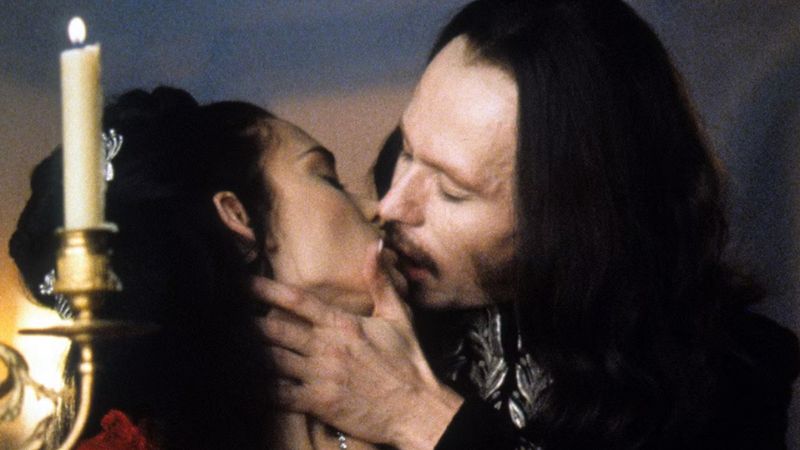
Francis Ford Coppola (director, 1992’s Dracula) is the only filmmaker who treated the lord of darkness with the dignity he deserves.
Interview with the Vampire by Anne Rice
Vampires are nothing if not Tumblr girlies. They want to yearn and be seen. So, of course, a reporter is the one chronicling his story.
There’s a transcendental logic to what nobleman vampire Lestat offers the distraught Louie, who is in shambles over the death of his brother: escaping humanity’s rules will free you from grief.
Rice digs deeper into the moral complexities of the vampire. For example, Lestat turns the girl-woman Claudia into a vampire—doomed to be forever 12—to ensure Louie stays back as his house-husband. (This is an incredibly queer genre, because queer=excess, excess=decadence, decadence=Gothic). Claudia confronts Lestat, leading to one bizarre plot development after another befitting a Spanish telenovela. Tom Cruise’s performance as Lestat in the 1994 film adaptation is a sight to behold.
The Hunger by Whitley Strieber
Anne Rice basically codified the vampire genre into mass-market pop-trash. Whitley Strieber took the first stab at the genre on its way to undergo a postmodern transformation within just a decade or more. The vibes are immaculate, but the aura and yearning is dispatched for a cold negotiation with the meat-and-potatoes business of procuring human bodies in an urban dystopia. There’s also an attempt to scientifically explain vampirism. The old god is dead, capitalism is the new god.
The late great director Tony Scott (Top Gun, Crimson Tide) made his feature film debut with an extremely flashy and stylish adaptation of the film starring David Bowie—accurately androgynous to play a vampire.
Black Ambrosia by Elizabeth Engstrom
This is an extremely interesting novel. ’80s America was infested with serial killers: the BTK killer, Green River Killer, Jeffrey Dahmer, what have you. Engstorm's novel, set in this time and space, particularly, rural Americana, is packed with loners, drifters and sociopaths. Our heroine Angelina may or may not be a vampire, or she might be a ravenous serial killer. There is no way to know.
Angelina’s weapon of choice? Her eyes. Here’s how someone who had crossed her path describes her.
Angelina. Like steel, she was. So hard she glinted. And it all showed in her eyes. Her eyes were—I don't know. Mesmerizing, almost. Like no other eyes I've ever seen. You know how sometimes you can look into someone's eyes and see love and softness? Well, when you looked into Angelina's eyes, you knew right off that someone was in there, lurking about. No God-fearin' mortal's got any right to eyes like that.
Lost Souls by Billy Martin
Formerly and best-known as Poppy Z Brite, Martin is a celebrated queer author in the horror genre. Lost Souls begins with a 15-year-old girl seduced, impregnated, and left behind by a sexy, red-flag vampire. (There’s a lot of seducing and pregnancy in this book). She dies. Her baby grows up to be a grade-A Goth brooder, aching for a band called Lost Souls?. The latent vampire renames himself “Nothing”. Sumptuous absurdities ensue.
What this book does is drag the genre away from the clutches of the aristocratic decadent vampire, his overdue moral redemption, and the saga of tormented villainy, and places it within youth subculture. It’s a very Gen X book. Lost Souls walked, so Twilight could run.
Let the Right One In by John Ajvide Lindqvist
This vampire love story between a bullied 12-year-old boy and an ageless vampire child moves with escalating violence feat. bad romance. When the vampire Eli's guardian is captured and killed, she begins killing on her own. When the boy Oskar is brutally attacked, Eli shows up to extract vengeance. Addiction, father's scourge and absence, paedophilia, poverty and social isolation are some of the heavy themes this novel carries. What's most beautiful though is the core of the romance: recognising a mirror in one another.
*****
Devarsi Ghosh is Consultant Editor at Advisory.
 souk picks