

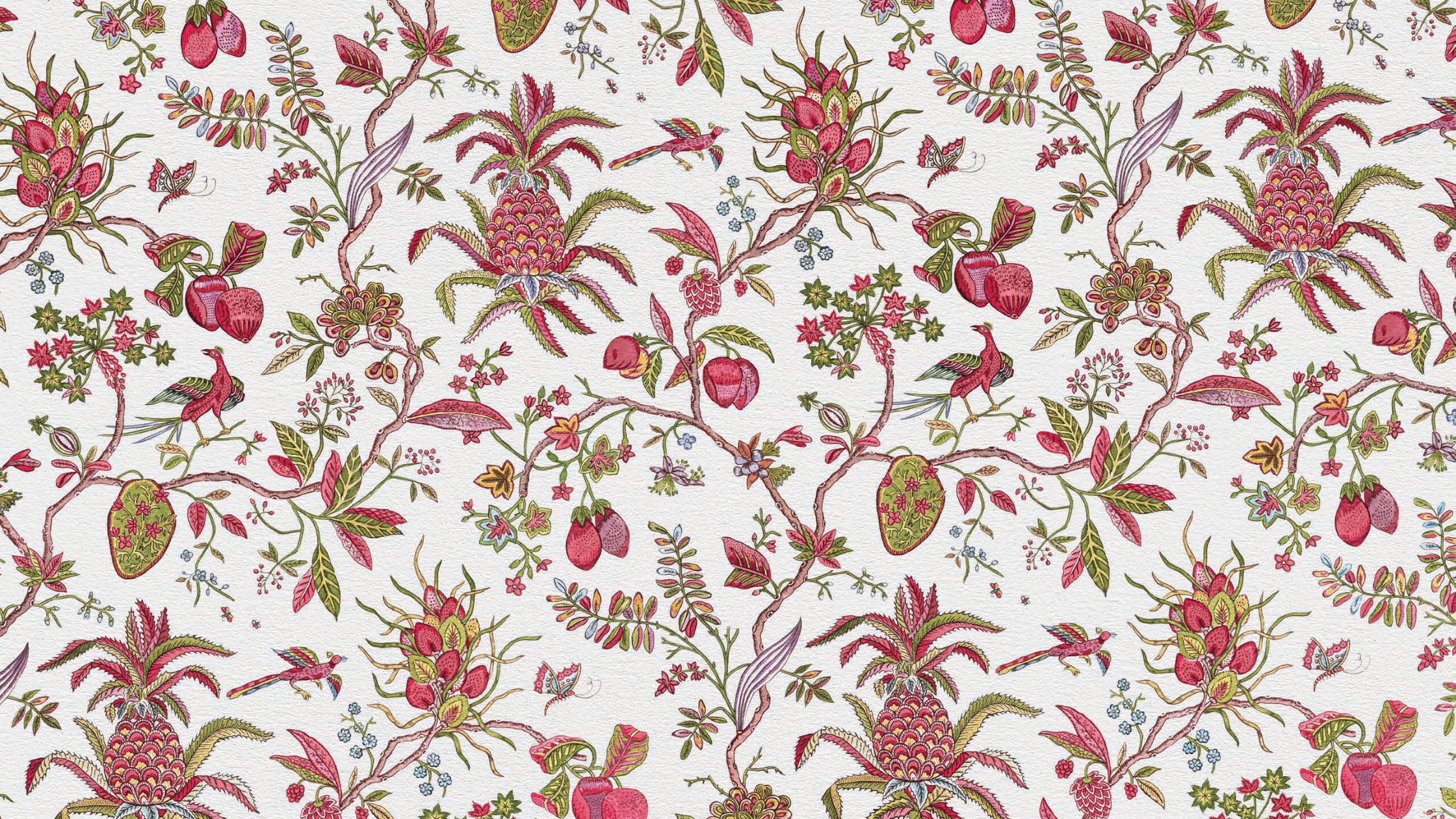
Like lovers’ kisses: The pineapple story
About Taste: Splainer’s new literary imprint, Taste, celebrates all that is exceptional about India—our singular design sensibility, literary voice, and perspective of the world—all of it rendered with deliberate excess. Taste, published by Juggernaut Books, is a book like no other—part art object, part literary magazine, and entirely its own world.
This first book features original essays by some of India’s finest writers, including Aatish Taseer on the ‘hotel aesthetic’ of living rooms, a rare conversation between Vivek Shanbhag and Parul Sehgal on how taste shapes the act of writing itself, and Srinath Perur’s glorious meditation on Boney M. and their enduring Indian afterlife. The book has been designed with extraordinary flair by Kriti Monga and Tania Singh Khosla. The video below gives you a fuller sense of its ambition and achievement:
Editor’s note: We feature Tania Singh Khosla’s gorgeous visual essay mapping the historical arc of the pineapple, from its unique, almost poetic sweetness to its use as a symbol of wealth and prosperity in society. And even its controversial position on a ‘Hawaiian’ pizza. Over time, the fruit has taken many forms and roles, emerging as an important, recurring motif in art and design: print, illustration, even architecture.
*****
Like lovers‘ kisses, she biteth —she is a pleasure bordering on pain from the fierceness and insanity of her relish.
Charles Lamb on the pineapple, 1822
On 4 November 1493, the natives of Guadeloupe Island served Christopher Columbus a fruit called anani, more widely known across South America as nanas (or ananás), which means ‘excellent fruit’. An impressed Columbus declared it ‘the most delicious fruit in the world’, and dubbed it the piña de Indes (‘little pine of the Indians’). Historian Pietro Martire d’Anghiera was less circumspect, cramming a basket of produce into a single sentence describing its virtues: ‘Fruits like artichoke, four times as tall, fruit in the shape of a pine cone, twice as big, fruit is excellent and can be cut with a knife like a turnip and it seems to be wholesome.’
Not satisfied with these efforts, the English would later add a new fruit to the mix—the apple—to more fully convey its seductive appeal. By the time John Parkinson wrote Paradisi in sole paradisus terrestris in 1629, the pineapple had elbowed out the original, boring apple in the Garden of Eden, appearing front and centre on the printed title page, flanked by the then wildly fashionable tulips. But apart from the English, the rest of the world has stuck with some variation of ananas. Portuguese traders—who called it abaxaci—spread the fruit far and wide, bringing its seeds from the Moluccas to India in 1548, where the Tamils renamed it annachi pazham. In a mere 100 years, humans across the world—from China to South Africa—were cultivating Columbus’s fortuitous discovery.
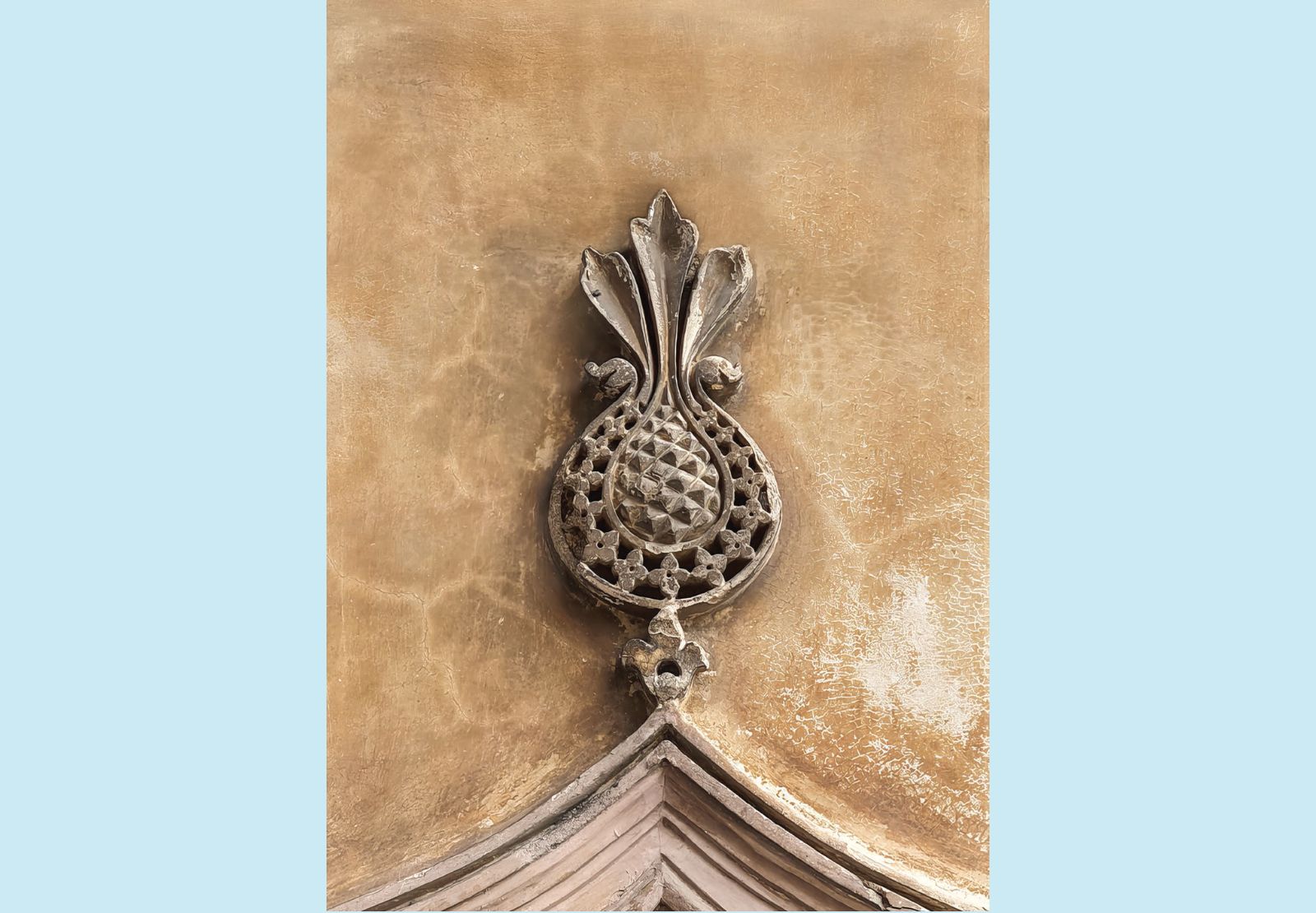
Thanks to both its rarity and sweetness (sugar being a scarce commodity in the sixteenth century), a staple crop of ancient Meso-Americans for over 3,000 years was reinvented as a prized signifier of privilege. In India, the fifteenth-century Qutb Shahi dynasty in the Deccan stamped the fruit on the minarets of the Charminar and the onion domes of tombs. A hundred years later, Hendrick Danckerts painted Charles II graciously receiving a pineapple from a kneeling gardener. The fruit was so expensive that it was often rented for display at prestigious banquets. The greater achievement, however, was to actually grow pineapples in your backyard—rather, in special heated greenhouses called ‘pineries’. The cost of growing a single fruit in Georgian England was around 80 pounds, the price of a new stagecoach with horses.
Back home, the pineapple took an unexpected detour, finding its way onto expensive bales of cloth exported from Machilipatnam. The port was one of two prominent sources of kalamkari on the Coromandel Coast. Where in Srikalahasti, weavers painted religious motifs for sacred canopies at the Srikalahastisvara Temple, their peers in Machilipatnam catered to the commercial and cosmopolitan requirements of a port city. Thus did the pineapple travel on yards of chintz sold everywhere from London to Bali. As with many aristocratic indulgences, mass production and economies of scale eventually robbed the pineapple of its grandeur. Thanks to new technology and slave labour, plantations in Hawaii churned out cheap cans of preserved pineapple in the early 1900s—making it a standard pantry item in middle-class households. Since then, it’s been quite a fall for the poor pineapple, from a symbol of royalty to a fruit most commonly associated with the execrable Hawaiian pizza—which was fittingly created not in Hawaii but in Canada, and by a Greek immigrant, no less. If it’s any consolation, there remains a pineapple on top of the Wimbledon men’s trophy, offering some residue of past glory.
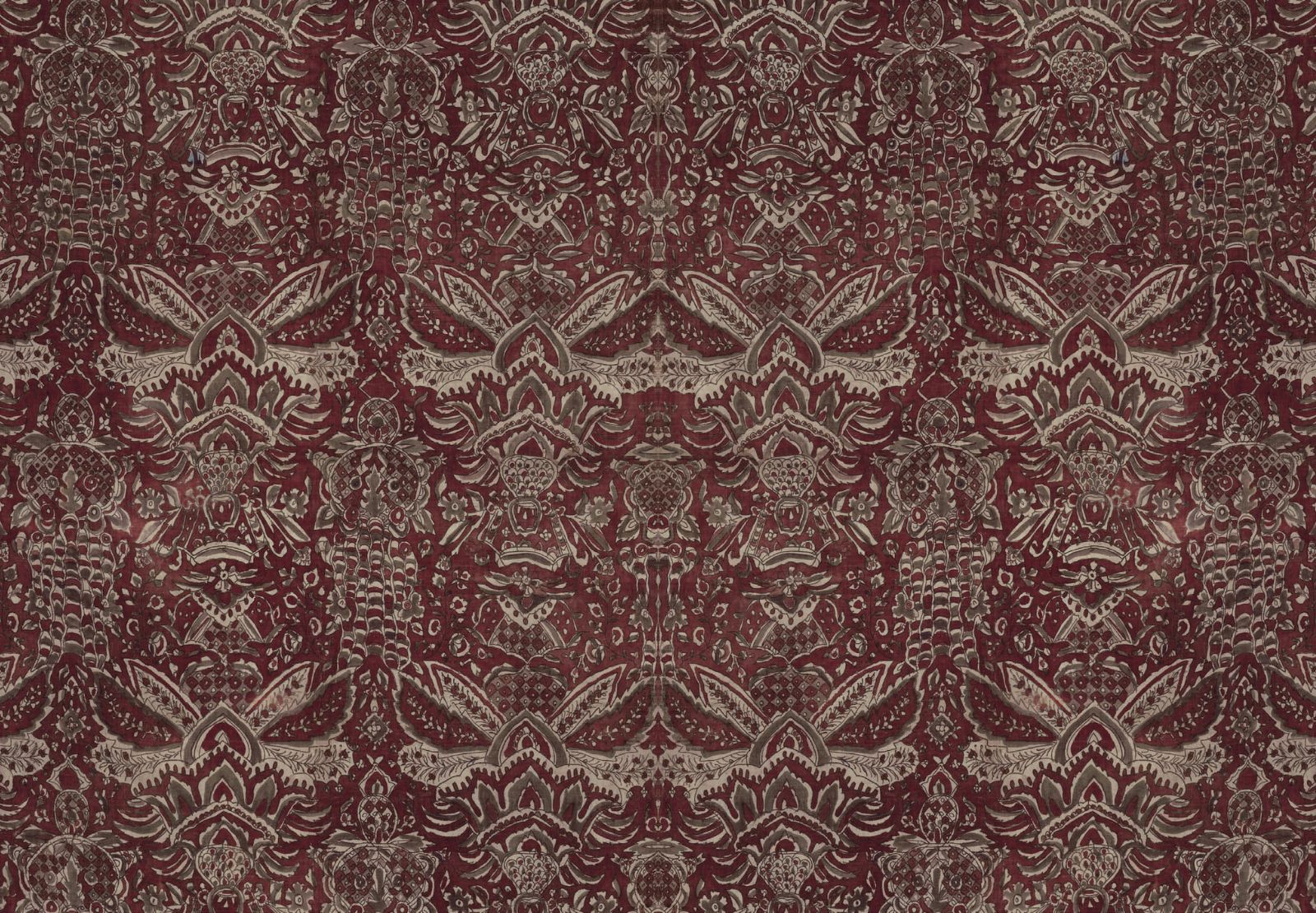
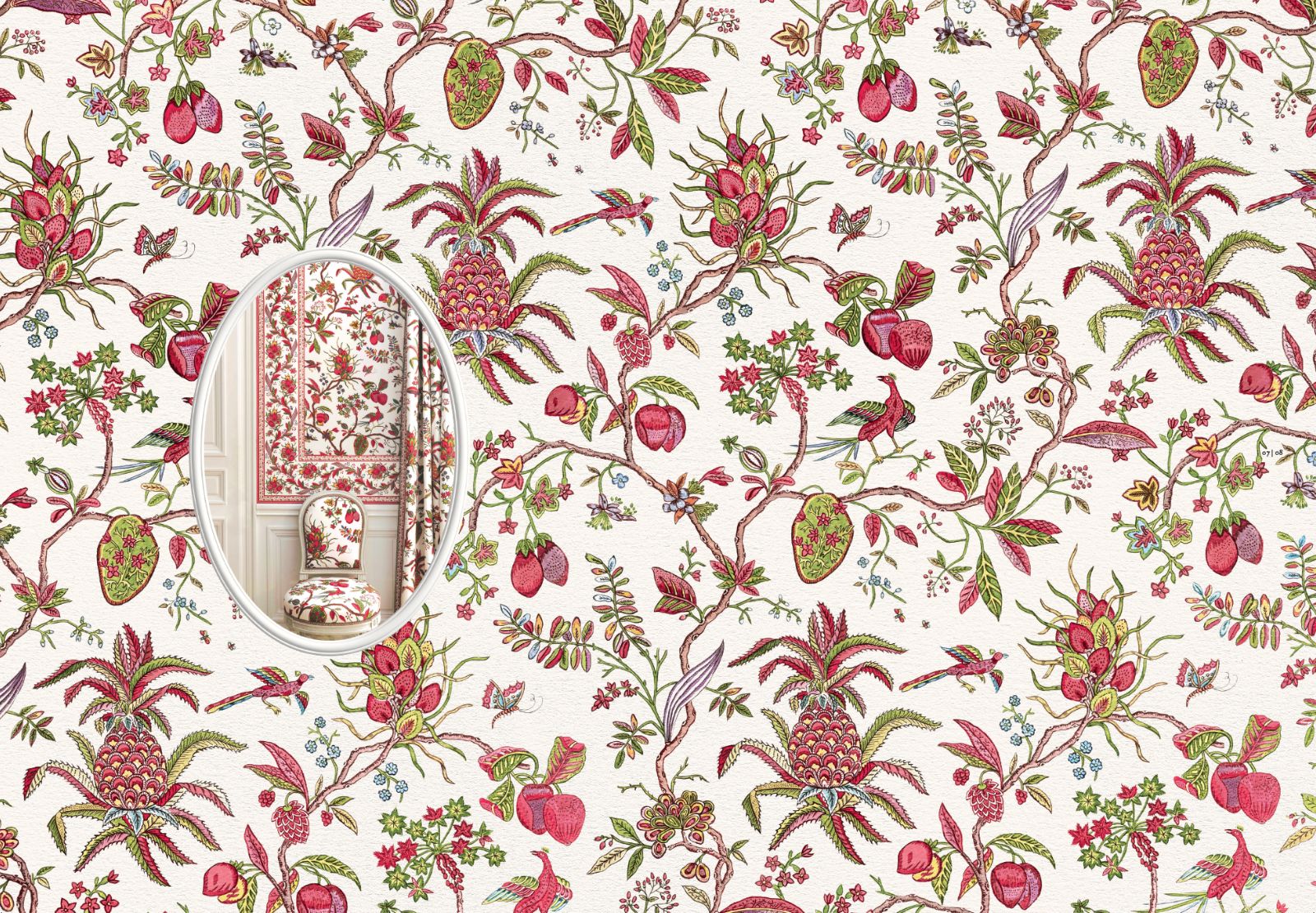
This cloth, currently displayed at the Metropolitan Museum in New York, was woven by kalamkari weavers on the Coromandel Coast in the 1720s. The ‘stylized repeating pineapple plant motif ’ is a freestyle rendition of lace-patterned woven silks that were fashionable in Europe at the time. But the cloth itself was intended for the Indonesian market. On the page right after the kalamkari print, you see the pineapples embedded in the pink-and-white floral pattern that decorated the walls and furniture of Marie Antoinette’s boudoir at the Château de Versailles.
The pineapple also became a signifier of hospitality for honoured guests. As this late-1900s fabric label shows, the criminally priced fruit was often a centrepiece at lavish banquets, in this case the Delhi Durbar in colonial India. In the words of Francesca Beauman, ‘It would also be displayed on the dining room table as a status symbol, and commonly it would sit there until it began to rot, because why on Earth would you eat a pineapple? It’d be like eating a Gucci handbag.’ The pineapple would later graduate to gateposts and door knockers as a decorative welcome sign for upscale homes.
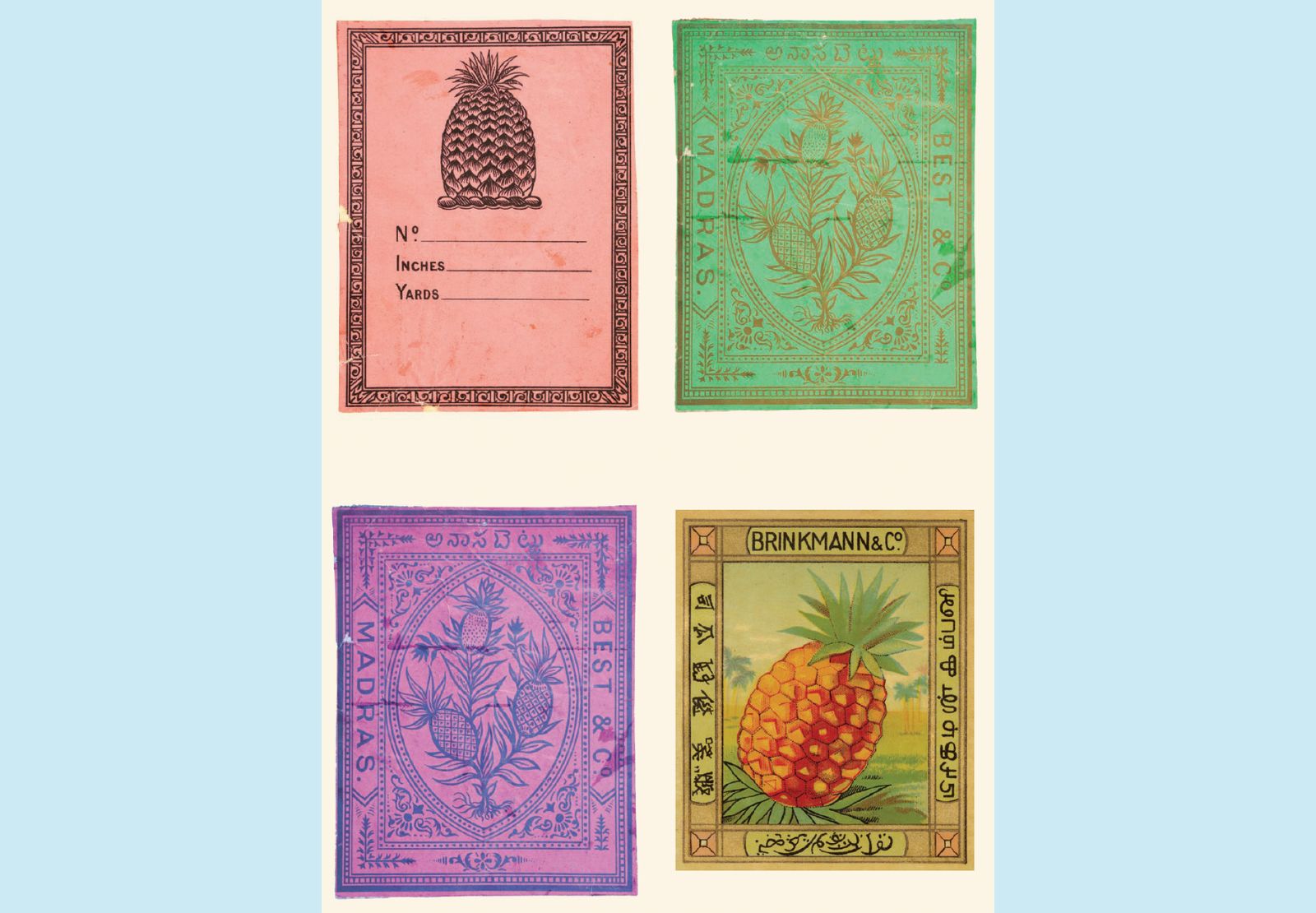
These are, in the words of author Sumathi Ramaswamy, ‘lavishly illustrated postcard-sized paper labels that were pasted on yardages of mill-manufactured cloth’—made in Britain and Europe. Called ‘textile ticket’, tika, or chaap, they served both as colourful trademarks and advertisements—much like the modern brand logo, ensuring instant consumer recall in the marketplace. They are also mementos of a colonial economy that enriched factories in Manchester at the expense of those kalamkari weavers of Machilipatnam.
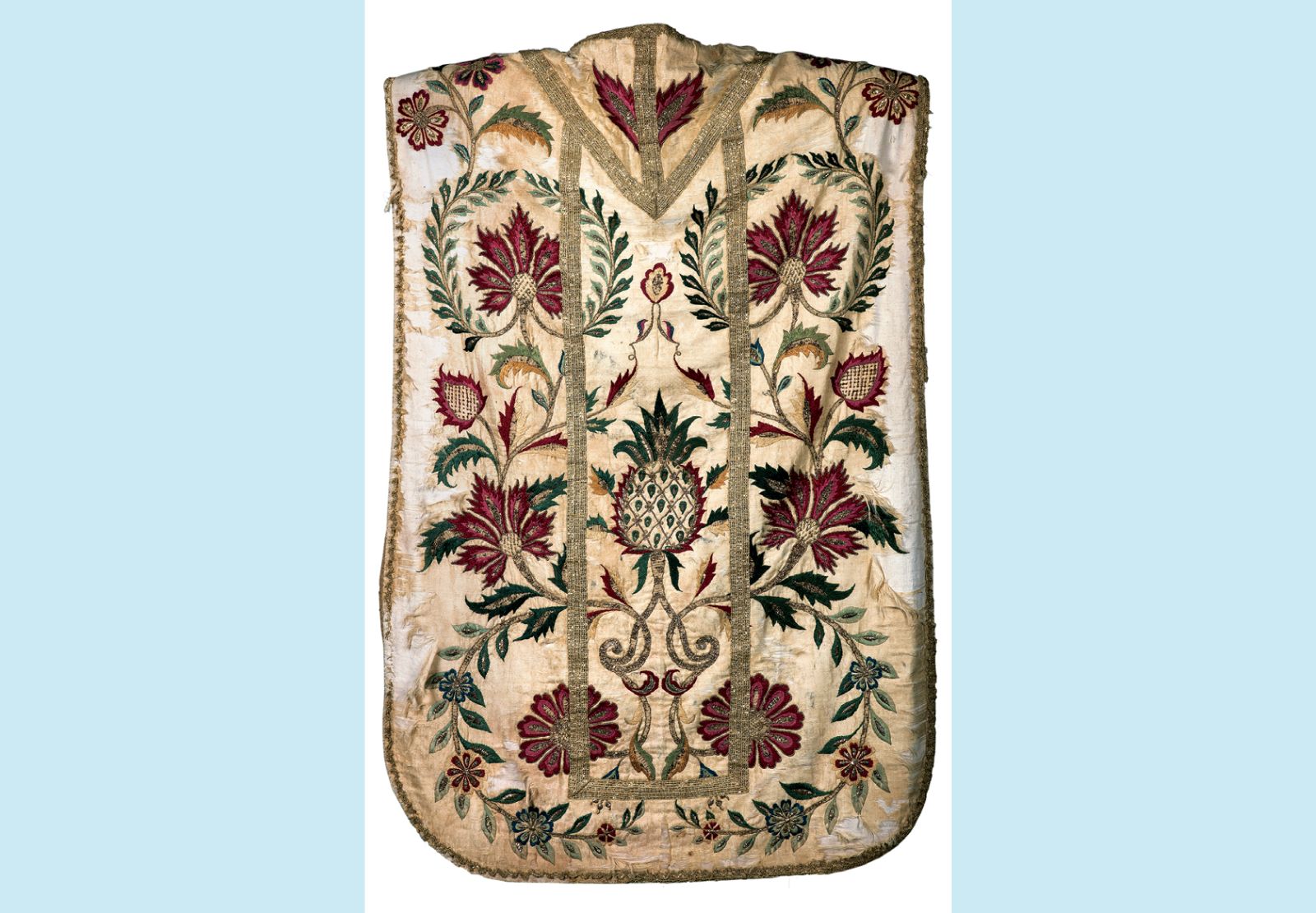
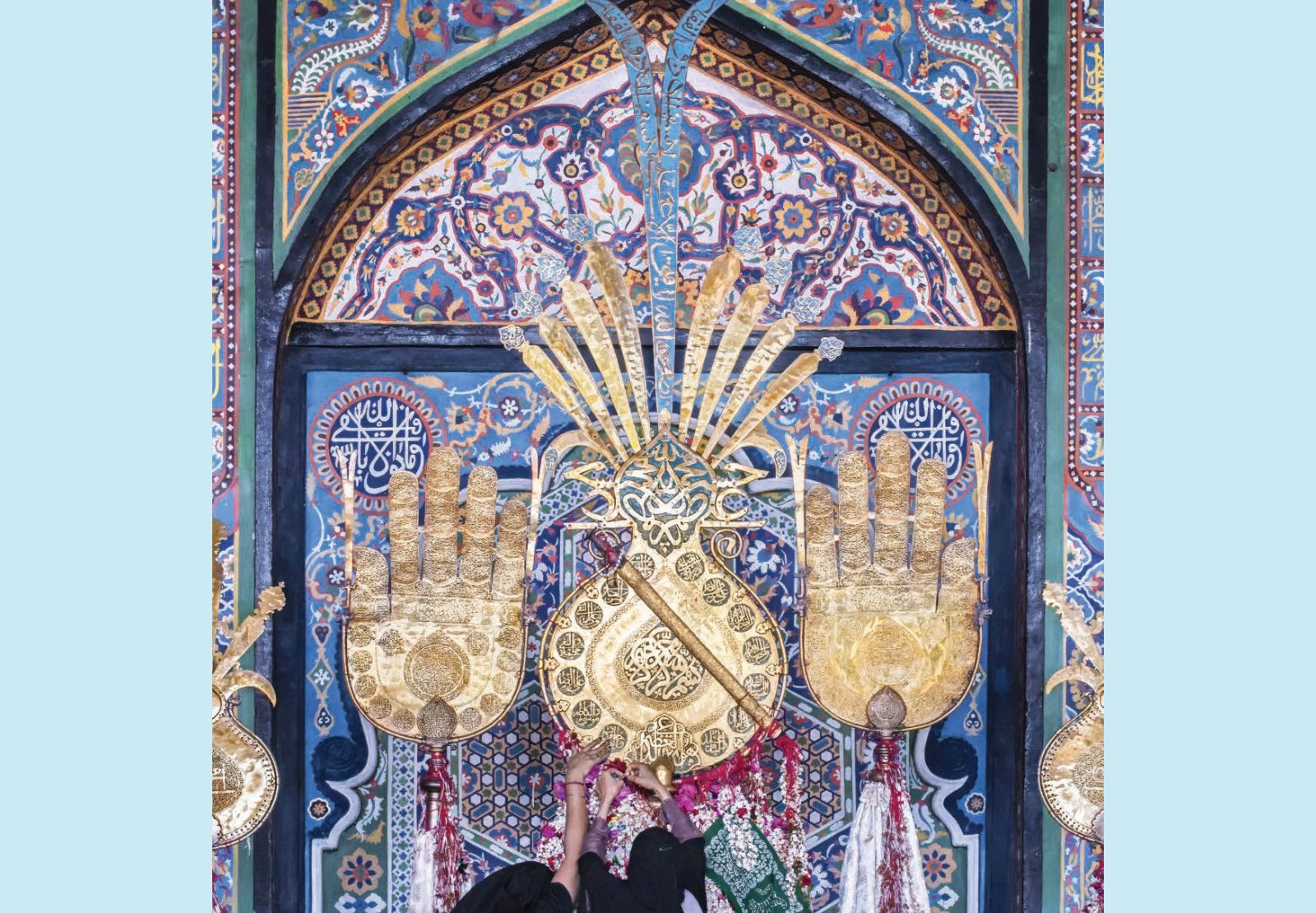
This is a chasuble, an outer vestment worn by Catholic priests during Mass. Currently on display at the Museum of Christian Art (MoCA) in Goa, this eighteenth-century garment has a gold-embroidered pineapple at the centre. Explaining its significance in Catholicism, MoCA curators say, ‘Just as Jesus gives His life for the salvation of the world, eventually dying on the cross, the Pineapple gives its entire life for one single fruit.’ In fact, the pineapple is a rare symbol to cross religious lines. Turn the page and you will see it gracing the mosaics at the Badshahi Ashoorkhana, the Shi’ite Royal House of Mourning in Hyderabad—and atop the St Paul’s Cathedral in London. The legendary architect Christopher Wren first intended to plonk a 60-foot pineapple atop the cathedral but settled for smaller ones on the two north towers instead.

In 2017, Studio Morison erected a pink pavilion shaped like an origami pineapple in an eighteenth-century walled garden of the Berrington Hall country estate in Herefordshire, England—bringing us full circle to those Deccan sultans. According to its artists, the 8 x 8 metre installation—titled ‘Look, Look, Look’—reflects ‘gaudy displays of wealth and taste [in Georgian England], bought at the expense of a hugely exploited underclass, that cover up a more fundamental rot within society at the end of its time’.


*****
(This essay originally appeared in Taste, edited by Lakshmi Chaudhry and published by Juggernaut Books.)
 souk picks