

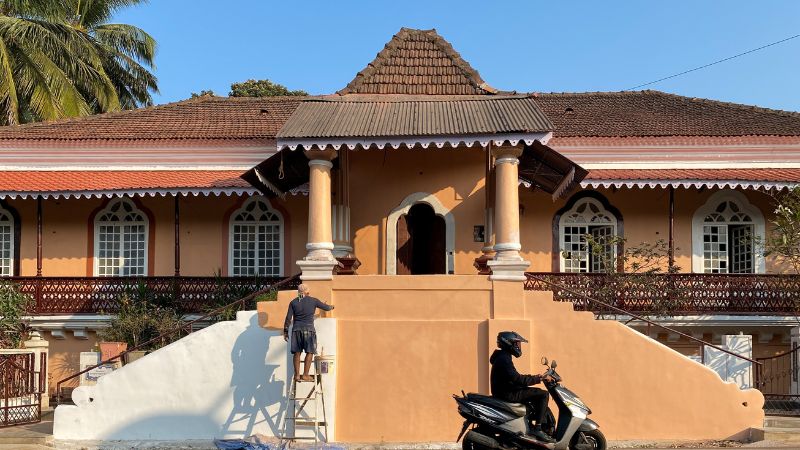
Gone, susegad, Gone: The occupation of Goa
Editor’s note: Goa has been overrun, in the past decade or so, by tourists and interlopers finding refuge there, often at odds with the susegad way of life that’s so essential to the experience of Goa. Naturally, this has led to an increasing gentrification of previously peaceful and calm neighbourhoods. This excerpt of journalist Seema Mustafa’s essay, ‘The Wannabe Colonizers or Some Such’ describes the unfortunate consequences of this invasion. This essay has been featured in Appetite, an anthology of short stories, poems, and essays about and from Goa.
The following excerpt from Appetite has been published with permission from Penguin Random House India.
*****
There are two lives being led here: the one the Goans lead and the other led by the visitors, some of whom own apartments and villas and spend the winters here. Both have hearty appetites. The Goans love their music, their food, the evening out, as do the visitors. The difference is that the Goans find the visitors too loud, too aggressive and unwilling to accept the gentle way of life. Susegad is not for the frenetic city walas who have come here to holiday, where holiday means an endless party. The quest for this is insatiable and can be seen in some of the restaurants known to the visitors who converge on these from the moment they land, till the time they leave. Goans avoid these same places like the plague and go indoors during the heavy tourist season, at least that’s how it seems. Their own lovely, homely haunts are not known to the visitors who prefer the more fine-dining trip, and are looking for the global cocktail instead of feni or urrak to satiate their thirst. The monsoons seem to be a favourite with Goans, as the rains keep the visitors away and Goa is at its most pristine and peaceful during the heavy rains.
Why does this kind of a disconnect happen? It is because the city dwellers of India look upon Goa as a holiday destination, and with the crassness that the north in particular is famous for, refuse to factor in the fact that human beings live here. People who have the same compulsions and responsibilities as any other, and they find it difficult to accept the indifference and, as many have told me, the sheer callousness that the visitors project. It was visible just the other night when a visitor, with probably a luxury villa or two in Goa, asked the musician with an amazing voice to play a particular number. This was just after the young man had said he would be taking a short break. So, when the request was made, he repeated this, saying he would play after the break. To which the visitor replied, ‘Okay, take your break’ in a tone that was most un-Goan and (to my now sensitized ears) rude, as it carried a kind of unnecessary permission that was not required as it was not being sought in the first place—an underlying superior, unmannerly tone that everyone at my table noticed, as, probably, did the Goan musician.
It was visible while strolling through Fontainhas in the signs that the residents have put outside their doors to warn the loud visitors to behave as people live in these homes, and it was not just vacant tourist land. An elderly couple sitting in their balcony enjoying the good weather had a meltdown when they found a gaggle of young tourists taking their photographs, as if they were some inanimate objects or animals on display. The gentleman stood up and shouted at them: ‘You Indians, go away, get out.’ His wife tried to calm him down, but he was furious, having clearly faced this intrusion several times before. The youths stood and watched, mouths wide open, as they tried to come to terms with the fact that their behaviour was indeed uncouth and intrusive.
In Goa, the visitor does not have to be overly aggressive; the way we speak and act in the north is sufficient to drive the locals away and prevent the amalgamation that alone can make a society healthy and vibrant. The growing result is a certain victimhood that the Goan has started feeling in the process of this ‘take over’ by north Indian city-walas. The other day as it rained heavily, a man on a motorcycle drew up to the car I was in and angrily said that we had splashed water on him. The car did not have a Goan number plate and hence was easily identifiable as an ‘outsider’ vehicle. The person driving the car first responded in Hindi pointing to the heavy shower, saying that there was no intentional splashing of rainwater. The man started arguing, and then the driver switched to Konkani, and within a minute the biker turned around and sped off. His desire to pick a fight with a non-Goan disappeared the minute he was confronted by a Goan! Or at least a person who had bothered to learn the language.
The visitor has an appetite for real estate. A very heavy appetite as is visible from the huge constructions taking place. Restaurants open within seconds, shut down too in minutes, and all builders and property agents are in a perpetual search for clients. They target the rich folk in Delhi and Mumbai and other such cites, with prices hitting the roof as prime land is given to the more politically influential among them. These builders mow through the trees to construct large complexes and luxury villas that are then sold for prices that make no sense to the Goan. The locals sit on the outside of these interactions and watch as the prices soar, and worry about the roof they have to fix, or the garden and plants they have to save.
*****
This excerpt from Appetite has been published with permission from Penguin Random House India.
 souk picks