
The art, the artist, the artmaking
Editor’s note: Art, photography, and conversation come together in Portrait of an Artist—a tribute to the artist and their studios. The book features a collection of intimate photographs, by Rohit Chawla, of eminent artists that have shaped modern India’s aesthetic identity over several decades. Kishore Singh, author and curator, provides the words behind the images—documenting his conversations with these towering figures of Indian art.
Here, we feature the stories of contemporary sculptor KS Radhakrishnan, cutting edge conceptual artist Mithu Sen, and abstract art figurehead and centenarian Krishen Khanna, each in their safe and nourishing environments where they create the magic we’ve all come to love.
Portrait of an Artist (photographs by Rohit Chawla and text by Kishore Singh) is published by Mapin Publishing in association with Kiran Nadar Museum of Art. The book is available to order at Mapin Publishing's website and other leading bookstores.
*****
I cannot breathe if I am not in my studio. It is my life. Alone, with the door shut, I dance, I sing…
Mithu Sen
b. 1971, Burdwan / s. Surajkund / p. Painting
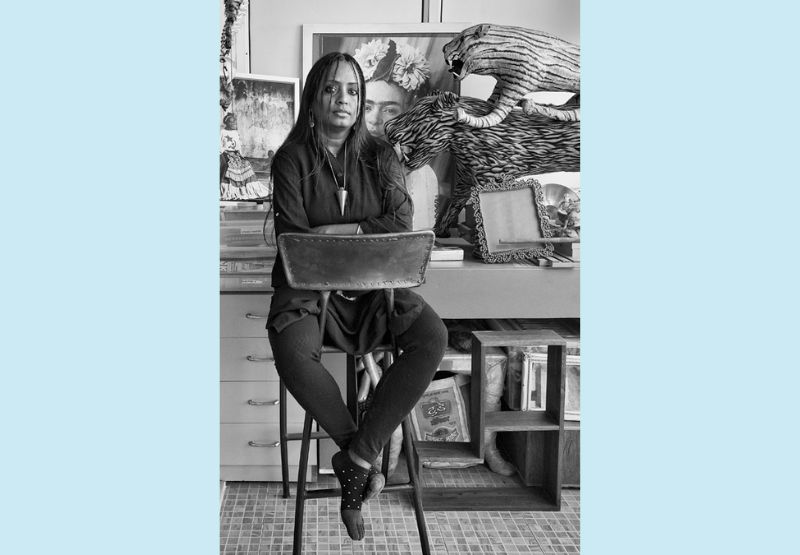
Spiritually a loner, preferring solitariness over company, Mithu Sen ponders over words like resistance, rebellion and sabotage, to explore subversion in her art practice. Violence of any kind becomes a trigger for her – personally as well as professionally – and she crafts her art from that same violence “so something beautiful comes of it.” She abhors pity or sympathy, challenges majoritarian perspectives, and bristles at the mention of politics. “Maybe I am a witch,” she says drolly when asked why her works are dark, “because I see evil.”
But Mithu is far from evil, attaching herself to people or relationships because she responds instinctively to genuineness, kindness, thoughtfulness. But she is also capable of dispassionately detaching herself from attachments of any kind. “What is home?” she asks. “I don’t know what home means. I am never homesick. I make and live in my own reality.”
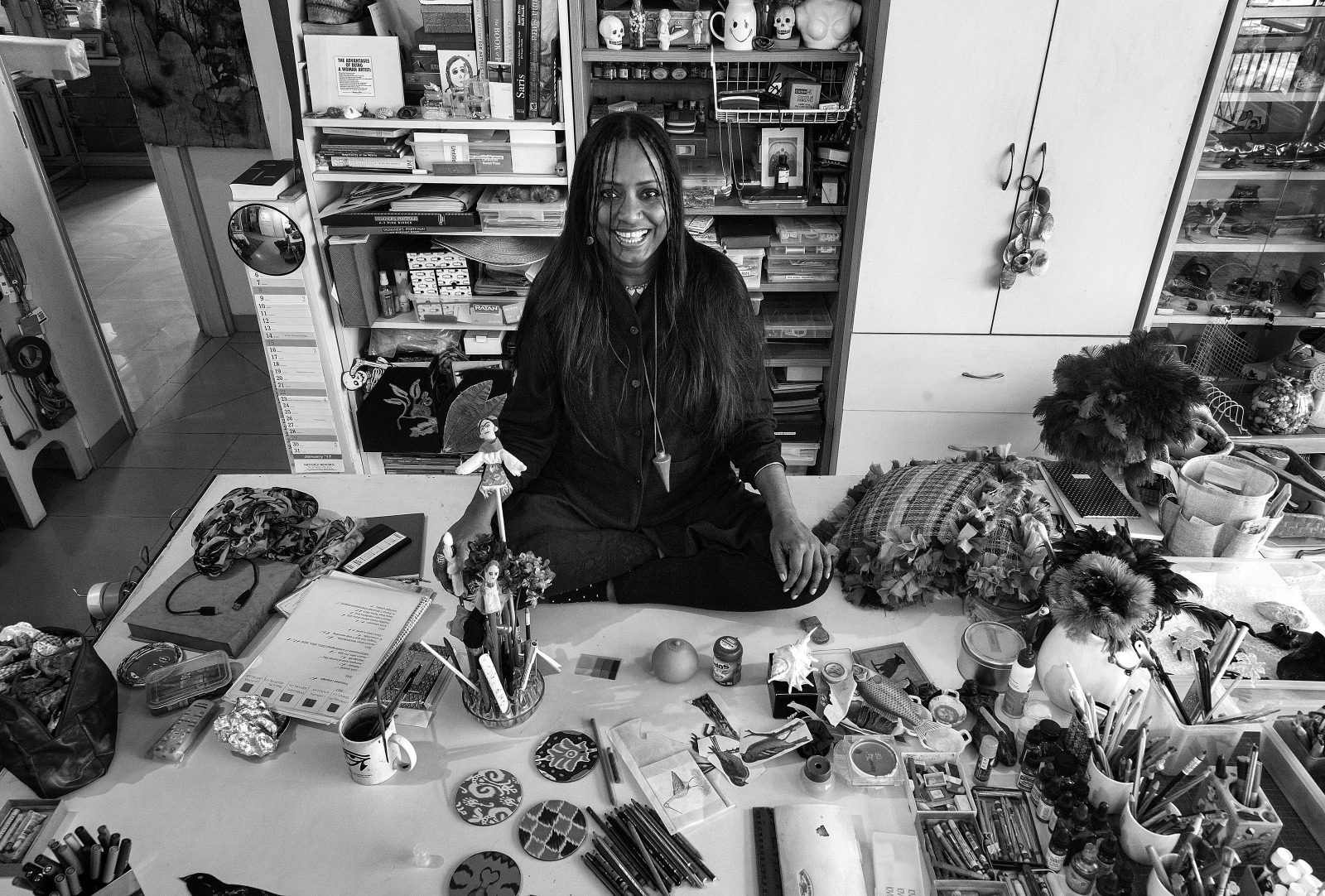
In her studio in Surajkund, she has created open rooms that lead from one to the other, opening them out to windows that overlook what was once a forest. Here she works from dawn to dusk and often later, sometimes staying over in a bunk bed because it’s easier than going home. “I carry my studio with me wherever I go,” she says of her frequent travels, “because if you are willing to throw yourself into the unknown, your body becomes your home.”
Like her chimerical personality, Mithu’s studio is a contradiction – open areas where she paints or collages, lined all around with her cabinets and shelves of curiosities: books, dolls, busts, ceramic mugs, glass vases, cards, posters, souvenirs, doodahs, toys, odds and ends, a dildo, skull, mermaid skeleton, breasts in different sizes, playing dice, wires, buttons, dried leaves, keepsakes. These are objects she hoards obsessively, carrying suitcases full of them from around the world, her Museum of Unbelongings that she is always pregnant with but will birth only once in several years. It is a space crafted with memories, an archive of her life and her practice. “But if someone says, leave this studio, I can – without looking back.”
*****
My studio is my sanctuary. It is where I am my most authentic self. I feel empowered and liberated doing what I love most.
Krishen Khanna
b. 1925, Faisalabad / s. Gurugram / p. painting
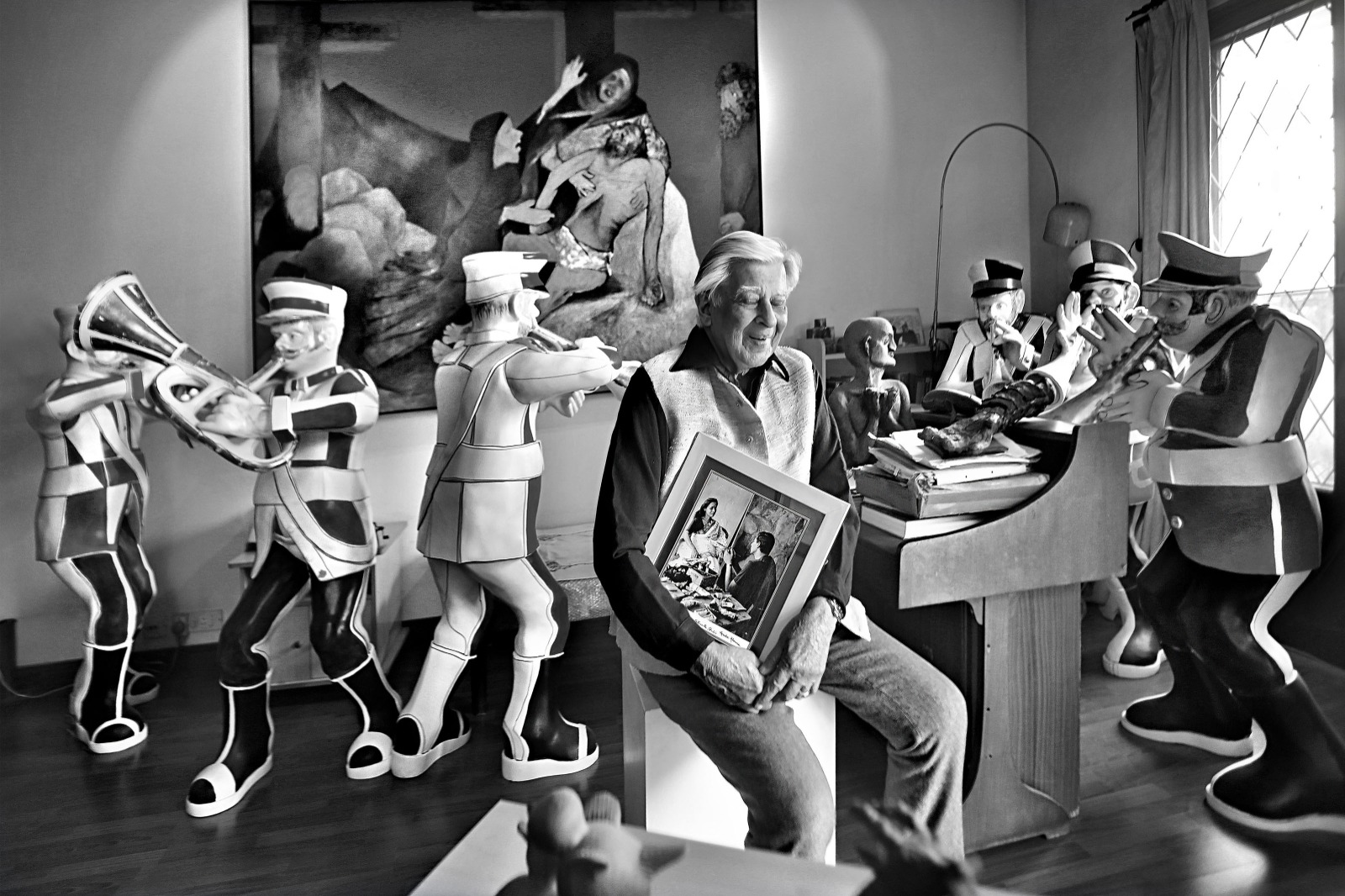
When I first met Krishen Khanna in 1980 at New Delhi’s Garhi, he was working on the largest commission of his career: a ceiling mural for ITC Maurya. Stacks of canvases were piled at the far end. Khanna sat on a wooden chair with arms before a canvas propped up on an easel. It was a gentleman artist’s space and Khanna has been both, an artist and a gentleman.
A far cry is his studio in Gurugram where he shifted when the city migrated to the suburbs. I recall descending down a narrow flight of stairs to the basement to find him perched on what looked like the same chair that he’d had in Garhi. Perhaps the same easel too. Tables were piled with his jars and tubes of paints, his brushes, all higgledy-piggledy, but there was clearly method in the madness. For he was able to pull out, without help, a recalcitrant catalogue, the exact brush, a particular photograph… Khanna enjoyed nothing more than chatty bantering livened up with some clever ripostes. Perhaps there was music in the background – I’m not sure – but he never offered tea in the studio, though lunch was available on the dining table upstairs. In the living room alongside, he enjoyed a read, and sometimes a snooze.
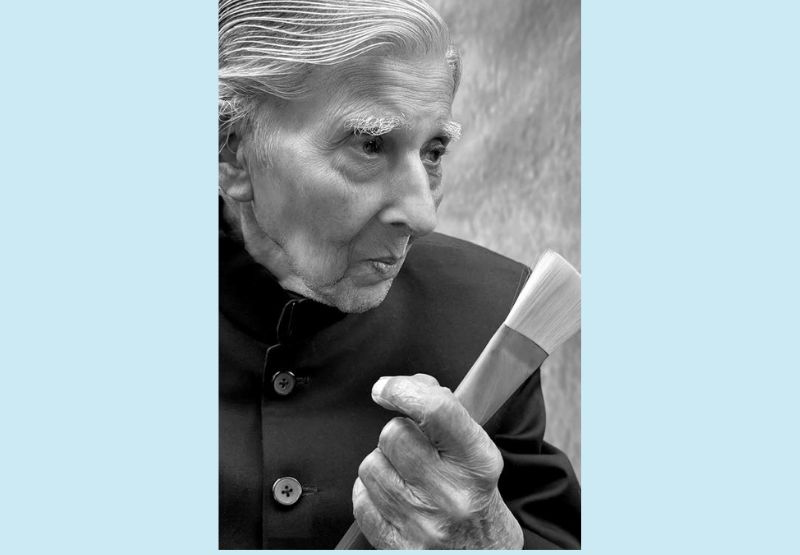
Khanna no longer goes down to the studio. It’s difficult to navigate, and he is 100 years old. The steps are lined with canvas, bubblewrapped, sealed and taped. The studio is silent, no longer an adda for conversations. I remember Khanna talking about the relationship between colours and how it mattered in the context of a composition. In Garhi, he had told me, “Art is a bitch!” I reminded him of it when we met recently over another interview. “I hope you didn’t quote me on that,” he chuckled, delighted as a child. As a matter of fact, I had, I told him, glad to have shared a memory with an artist whose studio was once painted bright with colours. The colours, like those irreverent conversations, are now of the past.
*****
Your studio reflects your soul. It’s where you are on your own, as an artist.
K.S. Radhakrishnan
b. 1956, Kottayam / s. New Delhi; Santiniketan / p. Sculpture
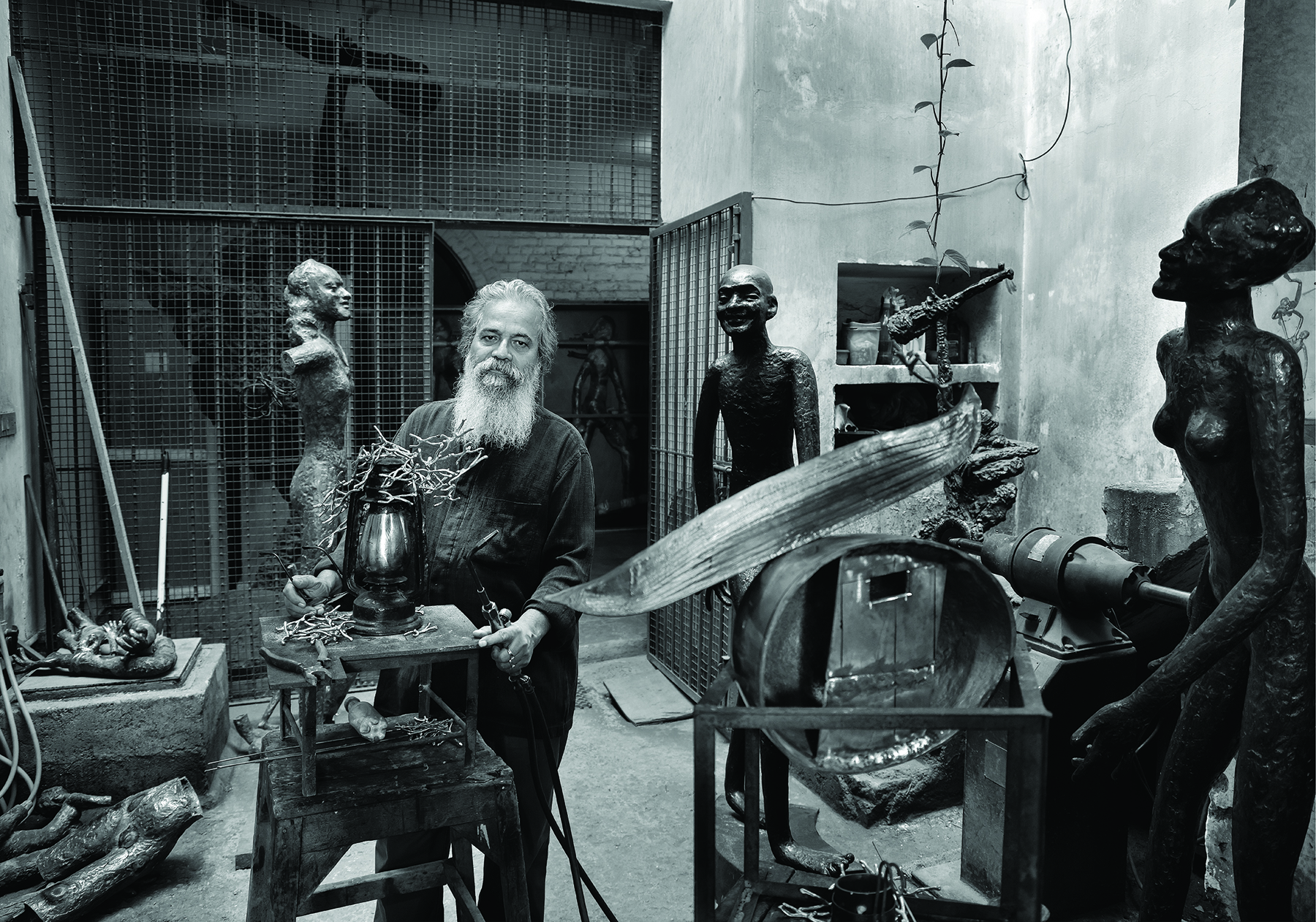
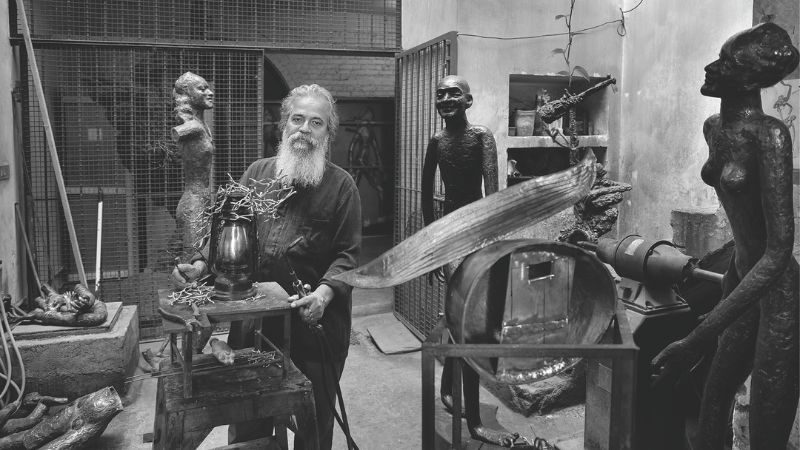
K.S. Radhakrishnan’s Santiniketan pedagogy bequeathed him his muse – Musui, a Santhal boy who assisted him in his studio and became the figure that he has since continuously contoured in his sculptures, quite literally shaping Maiya, the female alter-ego, from Musui’s ribs. (No, he doesn’t have a god complex). But there was something else too that he carried from his alma-mater: two shoots of the saptaparni tree that he planted outside the arch of his studio in New Delhi’s Qutub Minar precincts. Called the Alstonia scholaris botanically, graduating students at the university are offered the ‘leaf of knowledge’ from the tree, to mark the ceremony. Radha – as the sculptor who trained under India’s first modernist sculptor, Ramkinkar Baij, is popularly known – chose not just a leaf or branch, but whole trees to remind him of his educational and emotional connect with Rabindranath Tagore’s university.
Those trees, and others, grown tall since the decades when Radha planned his studio in what was then a sparsely habited area, filter the light that comes through the large windows. “It was my way of romanticizing Santiniketan,” he says, and, in fact, has a second studio in the university town where he works part of the year. If the studio in Delhi is necessarily vertical, that in Santiniketan is horizontal. Both are drenched in natural light.
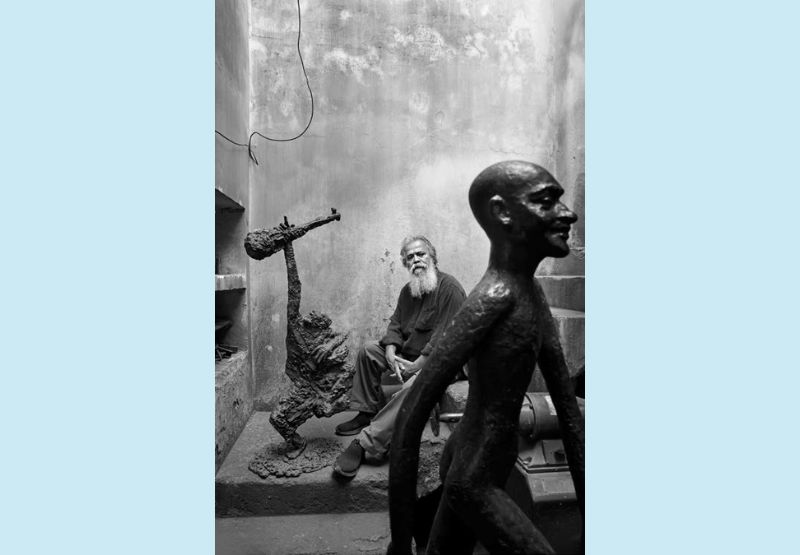
The labyrinths of the studio have finished, half-finished and just begun sculptures and figures that you might have to walk gingerly past to avoid being struck by a raised foot or flung hand in bronze, for Radha’s sculptured figures defy gravity and seem as much at home upside down. But if you notice that their population seems to have shrunk, Radha will tell you with a laugh that they’ve sought a new home in a gallery he’s opened in his Chittaranjan Park home, so visitors and friends don’t have to travel as far to make their acquaintance. You’ll hear no grumbling on that account, for Radha’s Musuis and Maiyas are a pleasure to catch up with, no matter their address.
*****
Portrait of an Artist (photographs by Rohit Chawla and text by Kishore Singh) is published by Mapin Publishing in association with Kiran Nadar Museum of Art. The book is available to order at Mapin Publishing's website and other leading bookstores.
 souk picks