

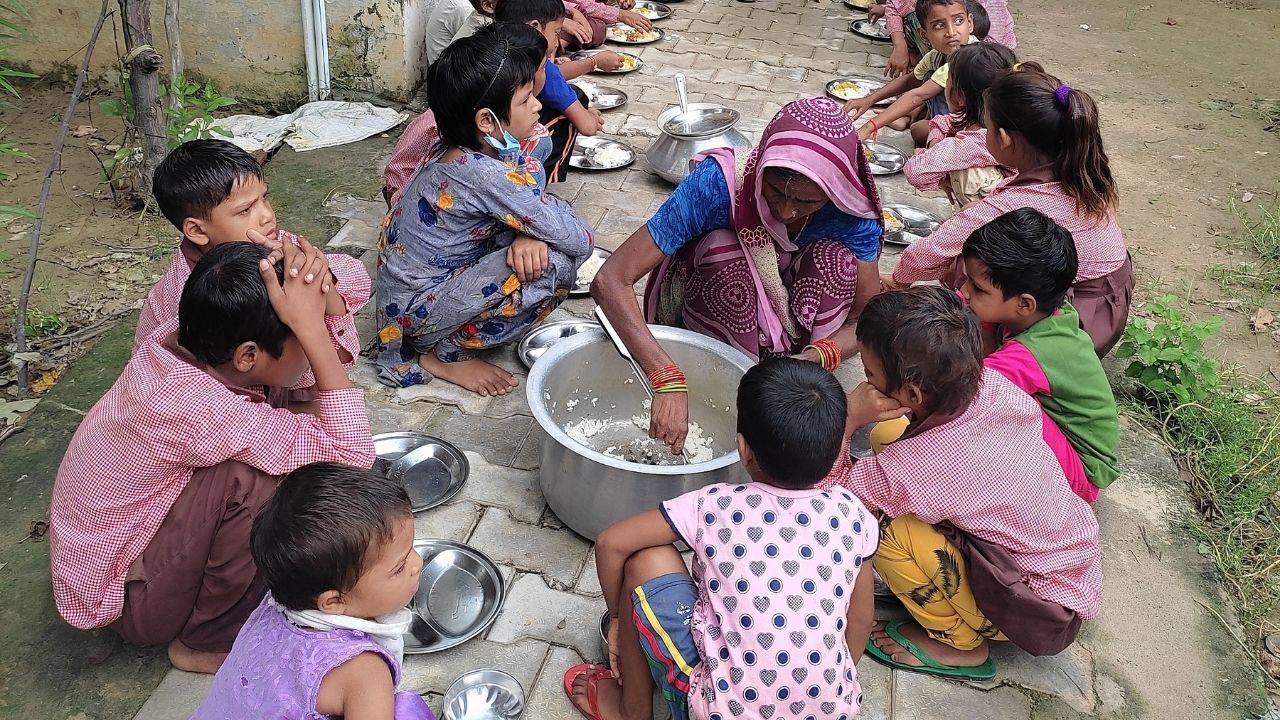
The Breakfast Club: India’s mid-day meals
Editor’s note: Freebies or Rights, a new book by eminent economist and professor Reetika Khera, is a comprehensive examination of India’s economic welfare architecture. Through extensive field research and case studies, Khera dissects these policies to understand how they can improve the quality of life for citizens.
In the following excerpt, Khera looks at the Mid-Day Meal scheme offered to children in school. The advantages of this remain plenty: from enrolment and attendance to healthy participation and nutrition. This excerpt from Freebies or Rights by Reetika Khera has been published with permission from Speaking Tiger Books.
*****
Mid-day meals are closely linked to children’s right to education. Meals help three aspects of schooling: enrolment, attendance and learning and socialisation. More than anyone else, perhaps poor parents understand the value of school education for their children. The promise of one meal can make school an even more attractive option and help ensure enrolment of the child.
If children are not treated kindly in school, then persuading them to go to school can be a task in itself. For many children, school is a place of joy, freedom and learning, while there are others who may not have a pleasant schooling experience—they are made to sit in the back, or asked to clean up, or subjected to caste abuse in other ways. In such an adverse environment, a hot, tasty, nutritious meal at school can help children see a more appealing side of the school and encourage them to attend regularly.
Children studying in government schools tend to be from poorer families. Many used to be sent off hungry in the morning, and in the absence of the MDM they only ate after they went home after school. It is quite evident that very little learning is possible on an empty stomach. If children are fed at school, they are likely to be able to concentrate better. From this perspective, the mid-day meal scheme is an integral part of education.
Several studies have documented these three effects of MDM on school education. Jayaraman and Simroth (2015) documented significant effects on enrolment between 2002- 2004, the early years of the transition to cooked meals. Afridi (2011) found that as a result of the transition from dry rations to cooked meals, daily participation of children was positively affected and the effects were larger for girls. Enrolment too was higher, though the effects were not statistically significant. Chakraborty and Jayaraman (2019) document its positive effect on reading and math scores; Afridi et al. (2013) find that learning efforts were higher among those children who had eaten the school meal in Delhi schools.
If nutritious meals are served, the MDM programme can also address under-nutrition. Many states have been providing nutrient-dense food items such as eggs, peanuts, black gram, soya bean, etc. Afridi (2010) found that among primary school participants, daily protein deficiency decreased by 100 per cent, calorie deficiency by almost 30 per cent and iron deficiency went down by 10 per cent. Singh et al. (2014) find that in Andhra Pradesh, the MDM protected children’s nutrition outcomes (captured by anthropometric indicators) from the adverse effects of a severe drought.
A few years ago, a colleague mentioned how in their decision on which (private) school to send their child to, whether the school served a mid-day meal was a crucial factor. Not only for their own convenience (both parents work) but also because when children carry lunch from home, they compare with others, and that can have an adverse effect on children. For example, if a child takes an egg sandwich, and another has instant noodles (say, Maggi), then children will be attracted to instant noodles, even though it is less nutritious. Moreover, the MDM scheme can be used to impart nutrition education.
When it’s time to eat, children first wash their hands, their plates, sit in row (or line up) to be served, sit together and eat. Each of these is important: handwashing before eating is a simple yet essential health and hygiene lesson. The importance of the habit of forming a queue cannot be over-emphasised in India. If children belonging to different social groups sit and eat together, it helps to break down social (especially caste) barriers. That, in turn, is an important step towards the creation of a democratic society. The MDM scheme can, thus, contribute significantly to enhancing social cohesion.
The Mid-Day Meal scheme has an important gender dimension. Sending a young child to school in the morning can be an event in some homes. It is not easy for parents (mothers tend to have this responsibility) to get their child ready for school first thing in the morning. Waking the child up, bathing and grooming them, either feeding or packing some food—each can be a task in itself. For working mothers, mid-day meals at school can lighten the burden of their daily
morning chores and can support them.
Further, almost all cooks and helpers employed by the mid-day meal scheme are women. Administrative data presented in Table A4 (Appendix I) suggests that in all states barring Bihar (63 per cent) and Gujarat (69 per cent), the share of female cooks and helpers is more than 80 per cent. Contrary to international trends, the participation of women in the workforce in India had been declining rather than increasing over time; it remains low even today. In such a situation, the fact that the MDM scheme provides employment to roughly 20 lakh women across the country is noteworthy.
*****
This excerpt from Freebies or Rights by Reetika Khera has been published with permission from Speaking Tiger Books.
 souk picks